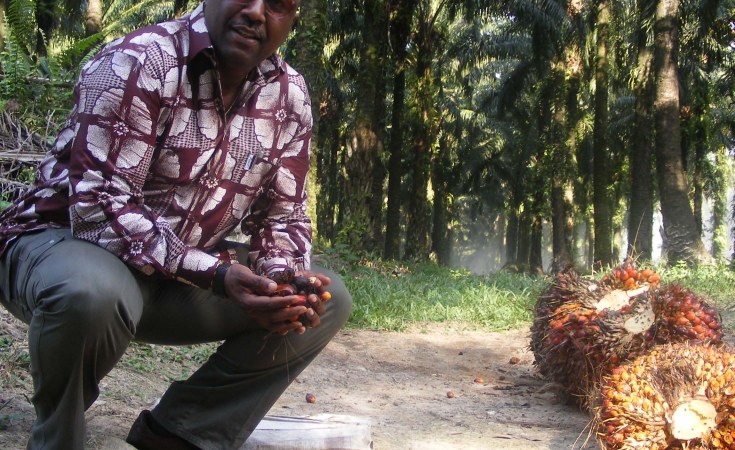
Monrovia — The Liberian government has announced that it is in the final stages of securing a U.S. $1.6 billion Indonesian investment in palm oil production which is expected to create 35,000 jobs.
Richard Tolbert, chairman of the country's National Investment Commission, told AllAfrica in an interview that the investment, in south-eastern Liberia, will give a major boost to the country's post-conflict economy.
"The government has about 33,000 persons on its payroll," he said. "Here we have one company that will provide jobs for about 35,000 persons. These jobs, I believe, will create livelihoods for about 300,000 to 400,000 people."
The investment deal is with Golden VerOleum, a company headquartered in Indonesia which is a subsidiary of Golden Agri-Resources (GAR), one of the world's leaders in palm oil production.
Tolbert said when the agreement is concluded, Golden VerOleum will need more than 200, 000 hectares for an oil palm plantation in the south-east, a region that is among the country's poorest. He said in addition to creating jobs and helping to decentralize Liberia's economy, the company has budgeted about $400 million for palm oil mills and eventually for refineries.
Relevant Links
"Not just crude palm oil will be exported out of Liberia," he said. "but there will be downstream processing as well." He said a social component of the investment should ensure that the company builds houses, schools and clinics in the area in which it will work.
The government recently signed another agreement valued at U.S. $800 million with Sime Darby, a Malaysian company, for a similar investment in the oil palm sector in western Liberia. Until now, oil palm production in the country has attracted little attention from multinational companies compared to Liberia's traditional exports – iron ore, rubber, timber, gold and diamonds.
The International Financial Corporation (IFC), a member of the World Bank Group, last year presented the government with the findings of a study that reviewed the country's oil palm sector, assessing its competitiveness and identifying potential investment opportunities. A press release quoted IFC resident representative Jumoke Jagun as saying that the sector has potential "to attract significant private investment, and to be a key driver of inclusive growth, development and job creation for the country."
Tolbert said the government had been engaged in discussions with Golden VerOleum for about a year. Arising from early contact, he and Agriculture Minister Florence Chenoweth had led a Liberian delegation to the company's plantations in Indonesia.
President Ellen Johnson Sirleaf 's administration has attracted a number of big investments from multinational companies since her election in 2005. Tolbert attributed this to good governance practices: "I believe we have decisively turned the corner as far as political stability is concerned," he said.

Arcelor Mittal, one of the world's largest steel companies, began operations in Liberia in 2007 following a re-negotiation of the terms of an earlier agreement. It also has an investment of U.S $1.6 billion, although its job creation potential is about a tenth of that promised by Golden VerOleum. Arcleor Mittal's operations have also been hard hit by the global financial crisis.
In an interview with AllAfrica last year, Joe Matthews, chief executive officer of Arcelor Mittal Liberia, said the country was making progress but there still was a long way to go. "There are a lot of companies coming in and bringing Western practices of good corporate governance," he said, but change was difficult. "It is not going to happen overnight but the will is there."
Another major investor is Buchanan Renewables, a company operating in the port city of Buchanan in Grand Bassa County. It buys old rubber farms, turns trees which have exhausted their potential into wood chips and ships the chips to Europe for fuel. The company is also helping to replant rubber trees and plans to construct a 35-megawatt power plant that will provide electricity from renewable sources to Monrovia and surrounding areas.
Liberia's economy was virtually shattered by the civil war that ended in 2003. An estimated 80 percent of Liberians were unemployed and the 2005 national budget totaled only $80 million. Taxes on the revenue generated by investments has helped the government to triple its national budget in just a few years, Tolbert said in the interview.

Comments 1 to 5 of 7 Post a comment
This is a step in the right direction for liberia. Mr. Richard Tolbert is doing a great job, bring in his experienced for Merrilyn Lynch, on wall street to bear in building up his country. We would need more people like Mr. Richard Tolbert who has passion towards the development of his country. This is a step in the right direction but they should also bear in mind that these contracts at the detriment of its own citizens and at a great advantage to the foreign investors
This is a step in the right direction for liberia. Mr. Richard Tolbert is doing a great job, bringing in his experienced from Merrilyn Lynch, on wall street to bear in building up his country. We would need more people like Mr. Richard Tolbert who has passion towards the development of his country. This is a step in the right direction but they should also bear in mind that these contracts should not be sign at the detriment of its own citizens and at a great advantage to the foreign investors. It should not be like the firestone 99years agreement that has defrauded the people of liberia couple with corrupt politicians who got their share of the pie.
I am not sure if this is the right investment for Liberia in 2009 when the rest of the world is seriously looking to the future in terms of investment into the future. Looking at the Firestone experience that brought nothing but increased poverty to that part of Liberia, we need to make better investment choices that will focus on skilled manpower development, better education, and technology. The projected 35,000 jobs that will be created as a result of this investment will be mainly in low skill labor.
Many young people in this area will be forced to make some hard choices between acquiring better education and getting labor job; the former which will have a long term negative impact on the overall development of that region. Learning from the Firestone experience, I strongly believe that investment in palm production in Liberia 2009 will come at a very high price in years to come.
I am not sure if this is the right investment for Liberia in 2009 when the rest of the world is seriously looking to the future in terms of investment into the future. Looking at the Firestone experience that brought nothing but increased poverty to that part of Liberia, we need to make better investment choices that will focus on skilled manpower development, better education, and technology. The projected 35,000 jobs that will be created as a result of this investment will be mainly in low skill labor.
Many young people in this area will be forced to make some hard choices between acquiring better education and getting labor job; the former which will have a long term negative impact on the overall development of that region. Learning from the Firestone experience, I strongly believe that investment in palm production in Liberia 2009 will come at a very high price in years to come.
Hi Richard Tolbert,
I am Charles Quagala D'Johns...Artist and Inventor in The United States of America. I was Born in Buchanan City, Bassa County, Liberia. I Graduated from Richard Henries High back in the Days. I did Teach at Christine Tolbert Norman School as Art and Government Documents Designer as well as MCSS High School. Also...I worked at Ministry of Education as Children Text books Designer under Ministers: Jackson Doe, Doris Bank Henries and Christine Tolbert Norman.
Currently, I am Investment Trader and Investor in Commodity, World Currencies, Futures, ETF's Precious metals, Iron Ore, Foods, Green Energies, Gold, Silver, Diamond and Nuclea Power Stocks.
I am Member of The Oxford Millionaire Club in Baltimore, Maryland USA. We do Investemt Trading and Investments.
In All Due deligence...Current Government of Liberia need to Outlines:
** Palm Oil manufacturing Plants Build on Liberian Lands to Train Liberians for Production Lines.
** Liberian and Foreign Investors as well as Institutional and Partner Investors... The Liberian Government MUST ALWAYS Control 60% of The Investment Contracts and 60% of The Work Force Administrations and ManPowers.
** The Liberian Government MUST ENFORCE All Businesses and Investors to PAY TAXES.
This Tax System Helps the Government to Create Non-Profit Organizations to Create Scholarships for Students and Business Minded People to go into Self Employed Businesses, they too PAY TAXES to the Government to RUN A WIN-WIN Partnership Economic Democracy.
** Liberian Government MUST SELL Only 20 % to 30% of It's PALM TREES to Indonesian or Sell The Extracted Palm Oil as a Finished Products in barrels or Containers to Indonesian.
** Remember... Mr. Richard Tolbert, Liberian Must Control 60% of it's Resources NOT THE Partnership Investors.
From: Charles Quagala D'Johns Artits/Inventor/Investment Trader 1484-162nd Avenue, Suite #21 San Leandro, California Golden State USA 94578 510-363-9145
GOD BLESS !!
See All Comments