Washington, DC — Liberian President Ellen Johnson Sirleaf is in Washington this week with a message that the country's post-conflict recovery, while still fragile, can become self-sustaining within a decade.
The visit includes a meeting with President Barack Obama on Thursday. Secretary of State Hillary Clinton, who returns from Asia earlier that day, is scheduled to join the two presidents at the White House. "President Obama is looking forward to the opportunity to discuss with President Sirleaf a range of important bilateral and regional issues," according to a White House statement released to AllAfrica on Monday. "We have maintained our links to the Liberian people through some of the country's most challenging times, and we remain deeply engaged now as Liberia continues to look to its future."
With an average annual growth rate of seven percent during the four years since she took office, Johnson Sirleaf told AllAfrica in an interview that Liberia is poised for a promising future, where its people can expect to get an education and find a job. The country has attracted pledges of large investments and has received substantial foreign assistance from a range of international donors, including the United States.
After 25 years of instability and civil war, the peace that has been restored, though fragile, has opened the way for progress in a number of areas. "Roads, water and lights have been restored in the capital city," she said. "Schools, hospitals and clinics have been built all over the country. We have a free society - sometimes we think too free! The media, free speech, free association, freedom of religion - those are all prospering."
Acknowledging that the country "still has a long way to go," the president lists as key challenges the creation of employment for thousands of unskilled youth and eradication of "the systemic corruption" which she says has embedded "dependency and dishonesty" in the country's value system.
"The unresolved pre-1980 historical challenges and the debilitating consequences of 14 years of civil war continue to define today's Liberia," D. Elwood Dunn, a Liberian political scientist and tenured professor at the University of the South, wrote in a report on Liberia published earlier this year by Freedom House. Dunn said in an interview that he hopes Johnson Sirleaf will use "the bully pulpit of the presidency" to convince Liberians to examine the roots of the country's divisiveness "so a new Liberia can be born."
Ties between the United States and Liberia date to the founding of the Liberian Republic in 1847 by former American slaves. Often neglected or overlooked by American policymakers, Liberia was nevertheless a staunch U.S. ally in World War I and II and sided with Washington during the Cold War, which came to an end about the same time Liberia's civil war got underway in late 1989.
The problem of corruption is expected to come up during Johnson Sirleaf's meetings with top congressional leaders from both parties. A report by the Congressional Research Service (CRS) released this week calls corruption "a key, abiding challenge," but also credits the Johnson Sirleaf administration with "a number of successes in fighting corruption."
Johnson Sirleaf will address the Council on Foreign Relations Tuesday before making her first official calls on Congressional leaders since her address to a joint meeting of the U.S. Senate and House in March 2006. A few weeks after the visit, Congress approved $50 million in immediate assistance for the new Liberian administration. Total U.S. development assistance and emergency aid for Liberia from 2006 through 2009 totaled $777 million, according to the CRS report.
"The United States greatly values its historic bonds with Liberia," the White House statement said. "The country is an important democratic partner that has made tremendous strides in consolidating stability, improving governance, and contributing to regional peace and development in recent years."
Liberian Ambassador Nathaniel Barnes said President Johnson Sirleaf plans to express appreciation "for the unparalleled support Liberia is receiving from the United States." The current level of assistance makes Liberia - a country the size of Tennessee with a population of 3.5 million people - the third largest recipient of American aid in sub-Saharan Africa, Barnes said in an interview.
Support for Liberia crosses party lines. Johnson Sirleaf was warmly welcomed to the White House on several occasions by the former president, George W. Bush, who awarded her the Presidential Medal of Freedom, the highest U.S. civilian honor. Since President Obama took office, the support has been sustained, Barnes said. Secretary Clinton, who has known Johnson Sirleaf for many years, visited the country on an seven-nation Africa trip last August.
"We have a very strong engagement with Liberia," Mary Beth Leonard, West African affairs director at the State Department said in an interview, with U.S. assistance focused on building democratic institutions and promoting economic development. "When you think about where Liberia has come from, it is nothing short of miraculous," she said.
On Wednesday, Johnson Sirleaf will be hosted at a breakfast by two leading congressional supporters of Liberia, Sen. Jack Reed (Democrat - Rhode Island) and Rep. Jesse Jackson Jr. (Democrat - Illinois), along with the chief executive of the Millennium Challenge Corporation (MCC), Daniel Yohannes. Based on progress Liberia has been making in a number of areas, the country has become eligible to receive assistance from MCC, which is an independent U.S. foreign aid agency created by former president Bush to assist countries that demonstrate they are effectively pursuing economic and political reform.
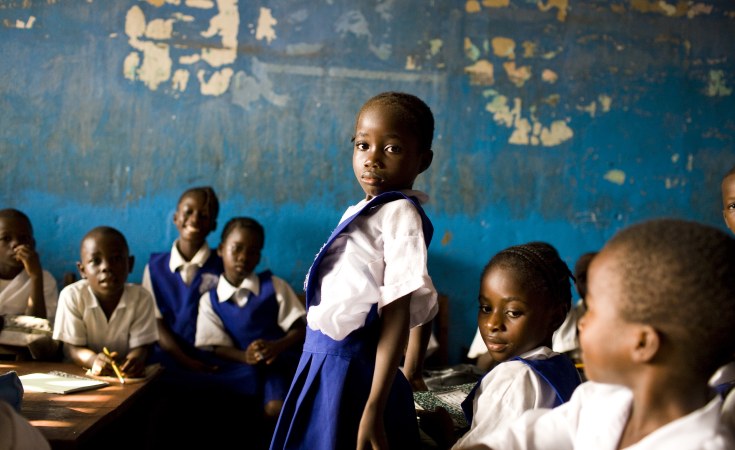
"When you look at President Sirleaf's reform agenda, it matches fundamental building blocks of the MCC - good governance, accountability, a pathway out of poverty through economic growth, job creation and private sector investments," Sheila Herrling, an MCC vice president, said in an interview. When approved by the board, the first phase of MCC engagement will provide about $15 million to Liberia for three initiatives - girls' primary education, land rights and access, and trade policy reform, which will help Liberia harmonize trade tariffs with its neighbors and other trade partners.
This initial involvement is through what the MCC calls a Threshold Program, designed to help countries become eligible for a "compact" with the MCC, which are large-scale in scope and funds. Of the 19 compacts signed to date, 12 are with African countries, including large programs in Ghana ($547 million), Senegal ($540 million) and Tanzania ($698 million).
The MCC program symbolizes the direction bilateral relations are moving, according to Riva Levinson, a Washington consultant who volunteered in Johnson Sirleaf's presidential campaign and has helped coordinate her U.S. visits since 2006. "She is seeking to define a partnership going forward based upon shared security and shared interests," Levinson said.
Johnson Sirleaf says Liberia cannot expect and should not want to receive assistance from the United States and other donors indefinitely. "Liberia can move from dependency to self-sufficiency in 10 years," she said in the interview. "We should be able, on the basis of our own natural resources, to finance our own development effort."

Sign up for free AllAfrica Newsletters
Get the latest in African news delivered straight to your inbox
The investment pledges Liberia has received help prepare the way for that transition. "There are lots of deals happening - valued at more than $10 billion," said Nicolas Cook, author of the Congressional Research Service report. These include large iron ore projects with the Chinese investment conglomerate China Union, worth an estimated $2.6 billion, with Australia's BHP Billiton ($2 billion) and Russia's Severstal ($2 billion), as well as several major agricultural projects and rubber deals, plus oil exploration contracts reportedly valued at $60 million.
Besides investment, Liberia still needs substantial international assistance. Minister of Planning and Economic Affairs Amara Konneh urged Friday that U.S. aid officials address the critical lack of human capacity in Liberia.
Speaking on a panel organized by Oxfam America, he critiqued the common practice of using foreign experts, who "come with huge administrative costs," to run development projects without training their successors. To become self-sufficient, he said, Liberia and other aid recipients must require that indigenous talent be cultivated. Local "ownership" and local capacity are essential elements of aid effectiveness, he said.
While Johnson Sirleaf's visit is not being cast as a search for increased assistance, the message from her administration is that smart aid - targeted towards capacity development and aligned with locally identified needs - is itself a good investment. Liberia's poverty reduction strategy "came out of a rigorous process of consultation and participation by people across the country," she said in her AllAfrica interview. "The best way to make development work," she said, "is to ensure that the priorities are established by the people themselves."

