

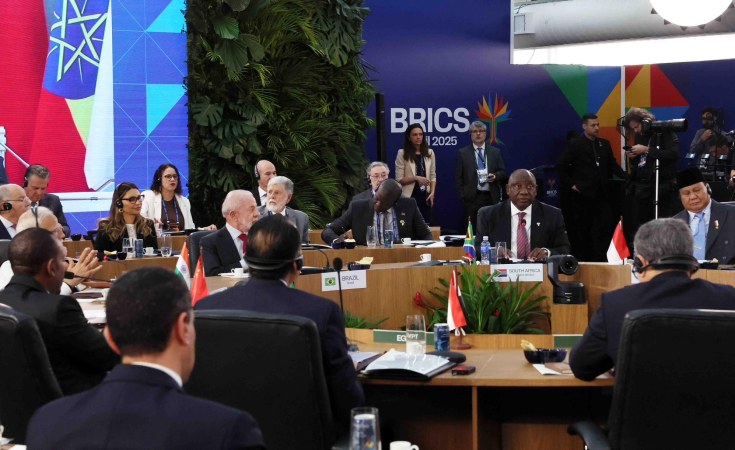
BRICS, comprised initially of Brazil, Russia, India, China, and South Africa, has expanded significantly since its formation.
Recent additions such as Egypt, Ethiopia, Iran, the United Arab Emirates, and most recently, Indonesia, mark its evolution from an economic bloc into a major geopolitical player.
Several countries, including Nigeria, have also been granted "partner country" status, and over 30 more have expressed interest in joining the group.
Spearheaded by China and Russia, this expansion has created a coalition representing more than half of the world's population and nearly 30% of global GDP.
Keep up with the latest headlines on WhatsApp | LinkedIn
For non-member nations, the question of joining BRICS is becoming increasingly strategic.
Membership offers access to financial resources, greater influence on the global stage, and the potential for stronger bilateral and multilateral ties.
As a founding member, Russia has consistently advocated for a multipolar world and a shift away from dependency on the U.S. dollar and Western institutions.
As Western sanctions against Russia tighten, BRICS offers a platform to deepen alliances with developing nations.
Ongoing initiatives such as creating a BRICS digital currency and independent payment systems underscore efforts to circumvent Western financial restrictions and develop a parallel economic infrastructure less vulnerable to external control.
The bloc is undergoing a dynamic transformation.
Establishing the New Development Bank, discussions around alternative currency systems, and regular high-level summits highlight BRICS's ambition to serve as a viable counterweight to Western-led financial entities like the IMF and World Bank.
As Brazil assumes the BRICS presidency amid escalating global tensions, shifting trade landscapes, and intensifying climate challenges, it faces the complex task of guiding a diverse coalition.
With the next BRICS summit scheduled for July 6-7 in Rio de Janeiro, Brazil can assert itself as a pragmatic leader, dedicated to multilateralism and global cooperation.


