

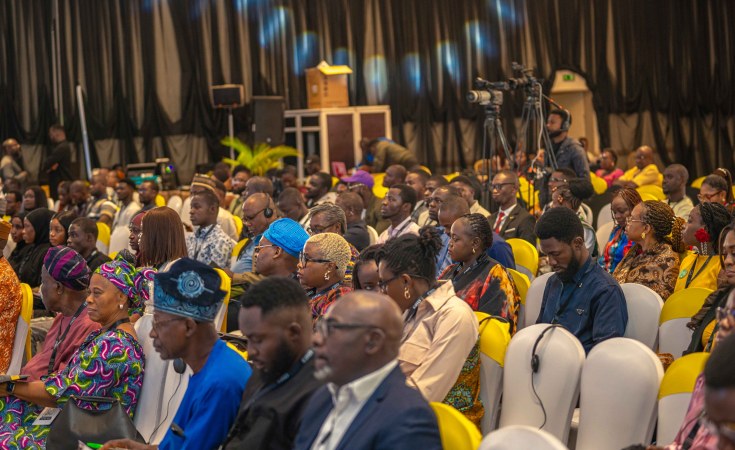
The plenary session, themed "Harnessing Digital Innovation to Achieve Food Security in Nigeria," was moderated by PREMIUM TIMES reporter Abdukareem Mojeed
Experts working across Nigeria's agriculture and food systems have called for the localisation of digital innovations to meet the realities of smallholder farmers, warning that the country risks widening its food insecurity gap if technology continues to be designed without farmers at the centre.
The concerns were raised at the ongoing Media and Development Conference (MDC) organised by the Centre for Journalism Innovation and Development (CJID) in Abuja.
The plenary session, themed "Harnessing Digital Innovation to Achieve Food Security in Nigeria," was moderated by PREMIUM TIMES reporter Abdukareem Mojeed.
Keep up with the latest headlines on WhatsApp | LinkedIn
Dorcas Omole, Manager at Sahel Consulting Agriculture and Nutrition Limited, noted that Nigeria's growing population and shrinking resources for food production have made digital innovation essential.
She explained that many of the tools currently promoted in the agricultural sector are not designed around the lived realities of smallholder farmers.
She said numerous digital platforms, including cloud-based systems, sensor-driven tools and real-time data solutions, remain fragmented and difficult for farmers to use.
According to her, funders and implementing organisations continue to prioritise their own objectives rather than the needs of farmers, which limits adoption.
Ms Omole stressed that wider uptake of digital solutions will only occur when smallholder farmers are placed at the centre of design and implementation.
She added that robust public-private partnerships and supportive policies are necessary to ensure that technology is accessible, contextualised and practical for farmers.
Inclusion of rural farmers
Winnie Lai-Solarin, a director at the Federal Ministry of Agriculture and Food Security, reinforced that technological solutions will remain ineffective if farmers' concerns continue to be neglected.
She highlighted the potential of tools such as smart farming systems, early-warning platforms and good agronomic practices to improve productivity, but noted that rural farmers are frequently excluded from the conversations where these tools are developed or deployed.
She added that trust remains a barrier in many rural communities, where farmers are hesitant to embrace government-led initiatives.
As a result, she said youth-led extension services are crucial for bridging the gap between technology developers and farmers, as they can interpret and deliver information in ways that rural communities understand and trust.
Operation in Nigeria
Daniel Joseph, CEO of Farm Monitor, stated that digital agriculture in Nigeria continues to suffer from heavy fragmentation across the value chain.
He observed that farmers, aggregators and transporters often work in isolation, making productivity forecasting, real-time tracking and efficient market access difficult to achieve.
He explained that estimating what a farmer can produce, based on land size, climate conditions and inputs, remains a challenge without a unified system.
Mr Joseph said Nigeria requires a central digital infrastructure that integrates data on inputs, yields, productivity and markets, ensuring a seamless flow of information across stakeholders.
He added that although multiple technologies exist in the market, adoption remains slow because farmers lack adequate support systems and licensing structures that would allow them to use these tools independently.

Sign up for free AllAfrica Newsletters
Get the latest in African news delivered straight to your inbox
He emphasised that farmers need training and trusted systems that they can operate without relying on daily supervision from external organisations.
The MDC is a yearly gathering that interrogates the intersection of media, governance and development across West Africa.
Convened by the CJID, the conference brings together journalists, policymakers, researchers, civil society leaders, diplomats, technology experts and development practitioners for in-depth conversations on the region's democratic trajectory and information ecosystem.
The third edition, themed "Reimagining Democracy, Development and Data for the Next Decade," explores how West Africa can strengthen democratic institutions, improve regional cooperation and harness data-driven solutions for inclusive development.

