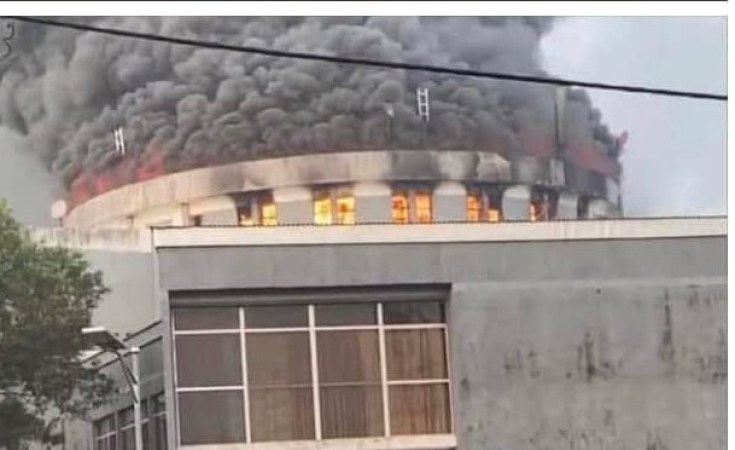
Monrovia — The prosecution's case in the Capitol Building arson trial came under renewed pressure on Monday, December 15, after its principal witness delivered testimony that repeatedly conflicted with an official investigative report he personally authored and signed--providing the defense fresh grounds to challenge the credibility of the state's evidence and advance an alibi for one of the accused.
Assistant Commissioner of Police Rafael Wilson, head of the Liberia National Police's Crime Services Department, was called by the state to explain how investigators linked the defendants to the December 18, 2024 fire at the Capitol Building. Central to his testimony were an empty chlorine bottle and a box of matches, which prosecutors allege were used to commit the arson.
However, under cross-examination, Wilson offered shifting accounts of where the chlorine bottle was discovered.
Follow us on WhatsApp | LinkedIn for the latest headlines
He initially told the court and jury that the bottle was found about 25 feet from where the Speaker of the House's vehicle is usually parked, near a vehicle bearing registration number HOR-98.
That account directly contradicted page four, paragraph five of the Special Investigative Report, which states that the Liberia National Police forensic team "lifted from the grounds of the Capitol Building, precisely around the William R. Tolbert Hall, an empty chlorine bottle with a blue cover."
Pressed to reconcile the discrepancy, Wilson adjusted his testimony, stating that the bottle was found "on the grounds of the Capitol," again approximately 25 feet from where the Speaker's vehicle is parked. Defense lawyers argued that the explanation failed to resolve the contradiction and instead underscored uncertainty surrounding the handling and documentation of critical evidence.
The inconsistency became more pronounced when, at the defense's request, the court clerk read the relevant portion of the investigative report into the record.
The report--signed by Wilson himself--clearly places the chlorine bottle near the William R. Tolbert Hall and confirms that a box of matches containing several sticks was found on the second floor of the building housing the Legislature's joint chambers.
Despite this, Wilson later testified that investigators found the chlorine bottle 25 feet from the Speaker's parked vehicle, while the matches were discovered on the second floor--an account the defense said selectively mirrored parts of the report while contradicting its most critical detail.
Questions also arose regarding vehicle HOR-98, which Wilson suggested was linked to the alleged arson. He testified that the vehicle was initially taken to Liberia National Police headquarters along with defendant Thomas Ethridge and others, but was later released after investigators concluded it was not connected to the incident.
According to Wilson, defense lawyer Cllr. J. Daku Massaquoi signed for the vehicle's release.
Moments later, however, Wilson claimed that investigators subsequently obtained information suggesting the same vehicle was used to transport individuals and materials allegedly connected to the arson and was therefore returned to police custody for further inquiry.
Defense counsel objected, arguing that the testimony was speculative and unfairly implied criminal use of the vehicle without concrete proof. They maintained that the questioning was necessary to expose contradictions in the state's case.
The defense further relied on call-log evidence acknowledged by Wilson, which showed that defendant Thomas Ethridge was at the Liberia Electricity Corporation (LEC) facility in Waterside at approximately 5:07 a.m. on December 18, 2024--around the time the alleged arson occurred.
Additional call-log data placed Ethridge near the Capitol Bypass at about 5:51 a.m.
Defense lawyers argued that the records establish a clear alibi, asserting that Ethridge could not have been at the Capitol Building during the commission of the crime. They emphasized that time-stamped electronic data creates reasonable doubt as to the defendant's physical presence at the scene.
Although Wilson attempted to defer detailed discussion of the call-log and GPS data, suggesting that an expert witness would later testify, the court instructed him to respond.

Sign up for free AllAfrica Newsletters
Get the latest in African news delivered straight to your inbox
He then acknowledged that nowhere in his testimony did he state that the Capitol Building was already on fire at the time Ethridge was shown to be at LEC--an admission the defense said further weakened the prosecution's timeline.
For the defense, the cumulative effect of the contradictions--between Wilson's oral testimony, the investigative report, and the call-log evidence--strikes at the heart of the state's case.
They argue that when a senior police officer cannot consistently explain where key evidence was found or how a suspect could have been present at the crime scene, the prosecution fails to meet the legal threshold required to sustain criminal charges.
As the trial continues before Criminal Court "A," defense lawyers insist that the inconsistencies exposed during Wilson's testimony have planted reasonable doubt in the minds of the jury--doubt they say cannot be cured by later witnesses or technical explanations.

