

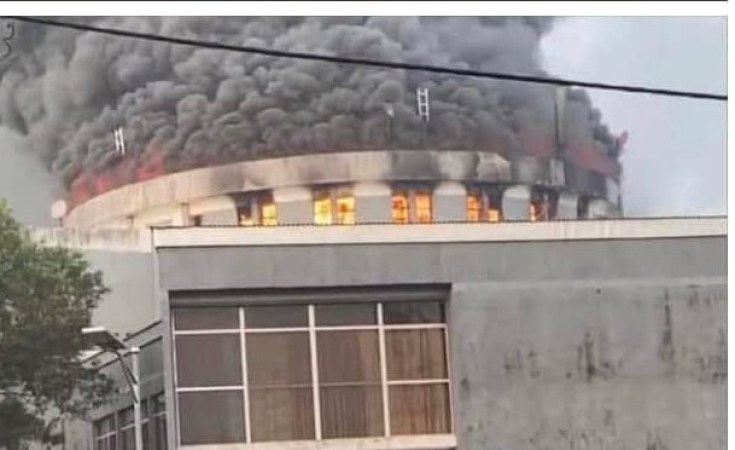
Liberia's Chief Police Investigator for the Crime Services Department, Reafeal Wilson, on Tuesday came under sustained pressure during cross-examination in the ongoing Capitol Building arson trial, as defense lawyers challenged the credibility of the fire investigation and the reliability of audio evidence presented by the state.
Wilson continued his testimony before Criminal Court 'A' as defense counsel Cllr. Arthur T. Johnson sought to expose gaps in the prosecution's case, particularly surrounding the role of an international fire expert said to have assisted the Liberia National Fire Service (LNFS)during the investigation.
Under questioning, Wilson told the court he could not recall the name of the international fire expert, nor the institution the expert represented. The response appeared to unsettle the courtroom, given that the state has relied heavily on the fire investigation to support its arson allegations.
Johnson pressed further, asking what conclusions, if any, the international expert communicated to investigators. The prosecution objected, arguing that Wilson was not competent to testify on expert findings and that the state intended to call the expert directly. Judge Roosevelt Willie sustained the objection.
Keep up with the latest headlines on WhatsApp | LinkedIn
Things heated up moments later when the prosecution asked the court to bar reference to a fire expert's report introduced by the defense. Defense counsel countered that the report was critical to exposing serious deficiencies in the LNFS investigation, including misstatements, factual inaccuracies, and conclusions unsupported by modern fire science and accepted investigative standards.
Despite the objection, portions of the report were read into the court record. According to the document, the LNFS investigative report lacked essential details, including the identities of responding personnel and clear descriptions of actions taken at the fire scene. The report concluded that given the magnitude of the Capitol fire, the investigation should have been thorough and comprehensive, but "unfortunately, this is not the case."
Cllr. Johnson further cited the report as stating that the Liberia National Fire Service lacked the training, experience and equipment necessary to properly collect, preserve and store fire evidence. The report also criticized the Liberia National Police for inadequate documentation of investigative steps and personnel involvement at the scene.
The prosecution dismissed the defense's approach as introducing "strange practices" into the proceedings. Defense lawyers rejected the claim, insisting that cross-examination is a lawful tool to test evidence and uncover the truth.
The court later turned its attention to an audio recording allegedly linked to defendant Dixon Seboe, which the state claims implicates him in the Capitol attack. Defense counsel questioned Wilson about whether he could conclusively identify Seboe's voice on the recording.
Wilson acknowledged under oath that he is not a voice analysis expert and that the audio does not clearly identify the speaker as Dixon Seboe. He said the individual in the recording referred to himself only as "Seboe," without further verification.
Wilson testified that the National Security Agency (NSA)assisted investigators by providing technical support and analyzing the recording. He said police investigators listened to the audio and concluded it implicated Seboe. However, under questioning, Wilson admitted that no formal voice analysis report had been produced and that no qualified voice expert had yet testified.
"You told the court you are not a voice expert," defense counsel said. "How then did you determine it was Dixon's voice?"
Wilson responded that a voice expert would be produced to explain the findings.
Defense lawyers also questioned Wilson about his interrogation of Seboe. According to Wilson, Seboe denied involvement in the alleged arson and said he learned of the fire only after waking up that morning. Seboe reportedly told investigators he later went to the Capitol Building after other government officials had already arrived.
Wilson confirmed that Seboe denied any role in the incident, that no force was used during questioning, and that these statements were accurately reflected in his investigative report.
The cross-examination unfolded against a backdrop of lingering public controversy over the handling of the Capitol fire investigation. In March 2025, fire experts from the United States, alongside the Liberia National Police, visited the burnt joint chambers of the Capitol Building to conduct an assessment.

Sign up for free AllAfrica Newsletters
Get the latest in African news delivered straight to your inbox
Critics questioned why international experts were invited after police had already concluded their investigation, charged defendants, and publicly named lawmakers as persons of interest.
At the time, Col. Coleman of the Liberia National Police told journalists that the U.S. experts were not conducting an independent criminal investigation but were tasked with assessing the cause and extent of the fire. He said their findings would be made public.
The three experts, Kenneth Prillaman, Mark Lynde, and Jerry Streich, all former fire chiefs from Minnesota with decades of experience, represent the Fire Rescue Alliance. However, sources familiar with the matter told The Liberian Investigator that the experts are not forensic investigators and lack the mandate to conduct criminal arson analysis.
The sources further disclosed that the U.S. Embassy in Monrovia declined involvement in arranging the visit, citing the political sensitivity surrounding the case.
The trial continues.

