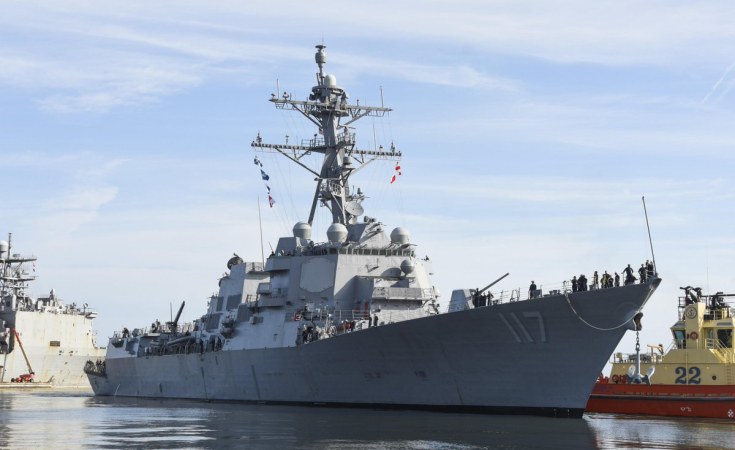
It is the ancient Chinese curse that says, "may you live in interesting times" - meaning a conjuncture of danger, chaos and upheavals. This is where the world and indeed Nigeria, find ourselves today. A few days ago, President Trump deployed an imposing military force in the Caribbean to threaten Venezuela including an aircraft carrier, at least seven other warships, scores of aircraft and 15,000 US troops -- for illegal attacks on small boats that he claimed were ferrying drugs. Last Saturday, Mr. Trump dramatically escalated his campaign by kidnapping President Nicolás Maduro of Venezuela and his wife as part of what he called "a large-scale strike" against the country. It was not an unprecedented action because the United States has done that in the past a number of times. The country has defined itself as a hegemon that does as it pleases to those who displeases it without recourse to law, ethics and basic principles of good behaviour.
The results of such American action are known. The overriding lesson of American foreign affairs in the past century is that attempting to oust even the most deplorable regime makes matters worse. The United States spent 20 years failing to create a stable government in Afghanistan and killed the Libyan President replacing a functional developmental state with a fractured state that set-in motion massive distribution of small arms and light weapons to entrench terrorism in Africa. The tragic consequences of the 2003 war in Iraq continue to beset America and the Middle East. The United States has also repeatedly destabilized Latin American countries, including Chile, Cuba, Guatemala and Nicaragua, by trying to oust a government through force.
President Trump claims that his administration's military adventurism is to destroy "narco-terrorists." We all know however that Venezuela is not even among the top ten drug suppliers to the US. The country is guilty of having the largest petroleum reserves in the world and the US has decided to take it over. In Mr. Trump's recently released National Security Strategy, he affirmed the right of his country to dominate Latin America: "After years of neglect, the United States will reassert and enforce the Monroe Doctrine to restore American pre-eminence in the Western Hemisphere." This is a formal announcement of the end of the rules based international order and the affirmation that might is right in the international system. Venezuela has become the first country subject to this neo-imperialism. There is no more need for international legitimacy, valid legal authority or domestic endorsement. The dictator does as he pleases.
Keep up with the latest headlines on WhatsApp | LinkedIn
In this context, it is difficult to understand how our president, Bola Tinubu, would go and beg President Trump to shoot missiles on Nigeria on Christmas evening, allegedly to kill Islamist terrorists. Did the Nigerian presidency not read the new national security strategy which states bluntly that all American action would only be in the interest of the United States alone and not any other country. The idea that the United States would act to protect Nigerian Christians who are suffering from genocide perpetrated by Islamic terrorists is as far from reality as can be. Nigeria's claim that it supplied the intelligence to the Americans to strike is beyond comprehension because if we have the intelligence, why did we not act on it. How would grovelling for help from a government that says it will only help itself be a rational policy.
I have so much nostalgia for the proud and assertive Nigeria of 11 January 1976 when our Head of State told the world and the American President, Gerald Ford, that Africa has come of age. In his speech at the OAU Summit in Addis Ababa, General Murtala Mohammed declared:
"Africa has Come of age. It is no longer under the orbit of any extra continental power. It should no longer take orders from any country, however powerful. The fortunes of Africa are in our hands to make or mar. For too long have we been kicked around: for too long have we been treated like adolescents who cannot discern their interests and act accordingly. For too long has it been presumed that the African needs outside 'experts' to tell him who are his friends and who are his enemies. The time has come when we should make it clear that we can decide for ourselves; that we know our own interests and how to protect those interest; that we are capable of resolving African problems without presumptuous lessons in ideological dangers which, more often than not, have no relevance for us, nor for the problem at hand. Nigeria has come to this Assembly determined to co-operate with you, Mr Chairman, and with all member States to put a stop to foreign interference in our Continental matters. As an African nationalist of distinction, I trust that your wise guidance will direct our deliberations to fruitful conclusions of which our peoples will be proud."
That moment of pride is difficult to find in Nigeria today as delegations after delegations go to the United States to beg them for the "help" they have said repeatedly they are not ready to offer. What we are doing in reality is asking them to come and take over our resources. What the invitation to bomb our country indicates an abdication of responsibility by Nigeria's political and military leadership. This event raises fundamental questions about sovereignty, constitutional governance, civilian protection, and the integrity of Nigeria's social contract.
As civil society groups indicated earlier this week, it is clear that Nigeria is in a dual crisis of leadership and security, and at the heart of this crisis is the apparent abdication by the President of the Federal Republic of Nigeria, Bola Ahmed Tinubu, of his constitutional role as Commander-in-Chief of the Armed Forces. By inviting a foreign government to manage what is fundamentally an internal security challenge, the President ceded sovereign authority in a manner that undermines Nigeria's constitutional order. Even more disturbing is that during and after the operation, the President, the Service Chiefs, and the leadership of the National Assembly were either on vacation or completely silent, leaving the Minister of Foreign Affairs, Ambassador Yusuf Tuggar, to publicly rationalise decisions that strike at the core of national sovereignty and democratic accountability.
This silence reflects a profound breakdown of institutional accountability mechanisms. Section 14(2)(b) of the 1999 Constitution (as amended) is unequivocal: "the security and welfare of the people shall be the primary purpose of government." This provision represents a central pillar of Nigeria's social contract. Any security action, especially one involving foreign military forces, must be grounded in transparency, civilian protection, and democratic oversight. None of these standards were met.

Sign up for free AllAfrica Newsletters
Get the latest in African news delivered straight to your inbox
Nigerians should be particularly troubled by the severe deficit of information regarding the nature, scope, legal basis, and rules of engagement governing the collaboration between the Nigerian and U.S. governments. Since the incident, Nigerians have not been informed of the basis for authorising the strikes, under what legal framework they were conducted, what safeguards were in place to protect civilians, whether the National Assembly exercised any oversight, or what accountability mechanisms exist for harm caused. This opacity fuels mistrust and undermines public confidence in government at a time when trust is already dangerously low. We are yet to receive any confirmation that any actual belligerent targets were hit. Nigerians were left to speculate about reports that debris from expended munitions fell on farmlands in different states of the country.
Yes indeed, we live in interesting times with many dangers on the horizon. As we all know, it is American bombs on Gaza that are executing the biggest genocide in recent history. The principal question posed is whether we have a Sheriff on board that is willing and able to serve the interests of the citizens of Nigeria.
A professor of Political Science and development consultant/expert, Jibrin Ibrahim is a Senior Fellow of the Centre for Democracy and Development, and Chair of the Editorial Board of PREMIUM TIMES.
