
In Ndiorol, in the Brakna region of Mauritania, Aminettou Bouchoueim recalls a time when she had to make daily trips to and from a well.
"I used to fetch water from a well that was often almost dry. I carried the containers on the back of donkey. It was only enough water till the next day when I had to make the same journey over again," the mother sighs as she remembers.
In this desert district of south-western Mauritania, a drinking water supply project has transformed the daily lives of villagers from a constant state of emergency to lasting stability.
"Today, I can drink with peace of mind and so can my goats. Much more than just water, this project has brought us stability, hope and dignity," Aminettou says and smiles.
In Ndiorol, water from a well was essential for drinking, washing and watering livestock. When the well ran dry, people had either to wait or set off again in search of a new water source, leaving everyone in a state of perpetual exhaustion, while uncertainty weighed heavily on families.
Despite its Atlantic coastline, Mauritania--at the crossroads of the Sahel and the Sahara--still faces major challenges in access to water. Nationally, only six out of ten people have a steady supply of drinking water and four out of ten people in rural areas lack secure access. In this arid country, water is limited and unevenly distributed: the only major sources are groundwater and the Senegal River. In this context, any initiative that guarantees water supply represents a strategic lever for public health, social stability and economic development.
An integrated response led by the African Development Bank Group
To address these challenges, the African Development Bank Group, in partnership with the Global Environment Facility (GEF), has implemented the Project to Enhance the Climate Resilience of Water Sector Investments. The project in Southern Mauritania is being carried through climate adaptation activities that are suited to the pastoral and forest resources of the region.
The project has received funding of $6.35 million. It complements the National Integrated Rural Water Sector Project, which is funded by a loan from the African Development Fund and a grant from the Rural Water Supply and Sanitation Initiative.
The project addresses many issues including the implementation of climate change adaptation measures such as sand dune stabilisation and the installation of protective systems, as well as tree planting. It has also supported income-generating activities in agriculture, forestry and livestock breeding, including market gardening and measures to support gum tree plantations.
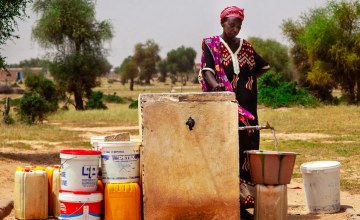
In Ndiorol, the project has involved the construction of a water tower, the installation of a submerged intake in the Senegal River, and a small water treatment plant. More than 60 household connections have been made, and four supply points that serve Ndiorol, Aroua and N'Diakré. The system is powered by solar panels, ensuring the continuous operation of submersible pumps and reducing dependence on conventional energy sources, even during periods of extreme heat.
The project has also provided water storage systems for agricultural and livestock use. Four drinking water supply networks utilising groundwater and surface water, and three water retention basins, have been created. The project has enabled the development of more suitable drinking water supply systems and promoted more sustainable water resource management, strengthening the crucial link between access to water and adaptation to climate change.
The project also focuses on capacity building at local level: local residents have been trained in the operation, upkeep and maintenance of water infrastructure, ensuring the long-term sustainability of water services and placing water management at the heart of regional development.
Access to water has also enabled more than 25 women to develop agricultural activities, growing vegetables for family consumption and local sale.
"The project has a huge impact. It's not just that we can drink - we can also produce food," says Aminettou.
Thanks to their produce, the women have been able to strengthen their financial independence and the food security of their communities.
Moulaye El Hassen Achour, a beneficiary of the project, highlighted its main challenges: getting equipment because of difficult road access, laying the pipes, drilling and installing the solar panels which required care and professionalism.
"This project opens up many opportunities for the community," he said.
In Mauritania, water scarcity is not only due to its uneven distribution but to a lack of infrastructure.
"In this project, we are mobilising water resources for domestic and economic needs, with extensions to the drinking water supply for some communities, retention basins and stations for livestock. Water security is a key element in building resilience to climate change," explains Alba Serna, manager of the project at the Bank Group


