

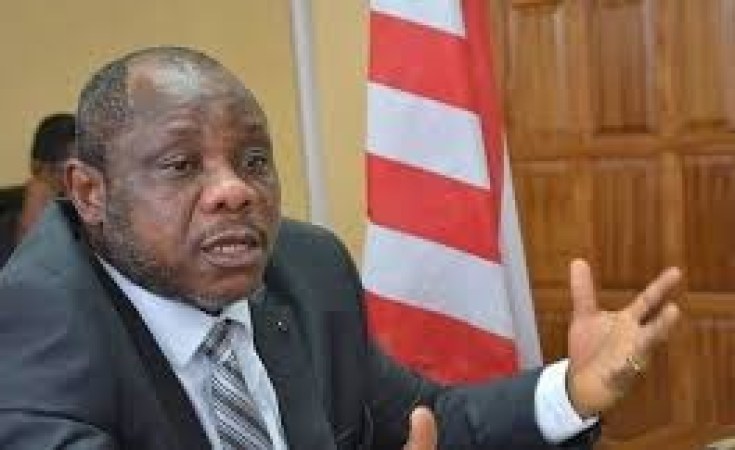
- In a dramatic turn in the ongoing trial of former Finance Minister Samuel Tweah, the Prosecution has effectively waived its right to challenge his central claims regarding legal authority under the Public Financial Management (PFM) Law.
The development follows weeks of testimony in which Samuel Tweah defended his decision to approve transfers totaling US$500,000 and LRD 1.05 billion to the Financial Intelligence Agency (FIA) for national security purposes.
Despite repeated assurances that rebuttal witnesses would be called to counter the former minister's interpretation of the law and his claimed authority, the Prosecution ultimately failed to present any financial or legal expert.
Keep up with the latest headlines on WhatsApp | LinkedIn
Legal observers say this omission could prove decisive. By leaving Samuel Tweah's detailed assertions unchallenged, the Prosecution has allowed them to stand uncontroverted, potentially strengthening the defense's position before the jury.
An analyst, speaking on condition of anonymity, suggested the hesitation may be rooted in current administrative practice. He noted that the present government continues to utilize similar authorities under the same PFM framework described by the former minister.
Other sources speculate that qualified experts may have been reluctant to publicly contradict positions grounded in both statutory law and long-standing institutional practice.
Rather than dispute the issue of authority, the Prosecution redirected its efforts toward defending the integrity of its investigation. Lead investigator Baba Borkai was recalled to the stand to respond to accusations by Samuel Tweah, who characterized the probe as speculative and lacking evidentiary basis.
Further testimony came from a Ministry of Justice coordinator, who challenged the claim that the FIA forms part of the National Joint Security structure. While the witness maintained that the agency is not formally listed under the 2011 National Security Law, the significance of this argument remains contested.
Defense witness Jefferson Karmoh had earlier clarified that communications with the FIA involved designating a code channel, rather than any formal admission into Joint Security. The defense has consistently argued that the law provides for automatic inclusion of all national security entities under Section 2
The Prosecution's argument faced further strain following a juror's inquiry into how membership within Joint Security is determined.
In response, the Prosecution's witness stated that the Minister of Justice has the authority to determine membership--an assertion widely viewed as inconsistent with statutory provisions defining such membership. Observers note that this response undermines the Prosecution's theory that participation in Joint Security required explicit approval, thereby echoing assumptions already challenged by the defense.

Sign up for free AllAfrica Newsletters
Get the latest in African news delivered straight to your inbox
As the trial approaches its conclusion, analysts suggest the Prosecution's case has lost coherence. Initially built around the claim that Samuel Tweah lacked legal authority, that argument now appears significantly weakened in light of the defense's evidence and testimony.
In response, the Prosecution appears to be shifting focus toward the issue of accountability for the funds--a line of reasoning that had not featured prominently at the outset of proceedings.
However, this shift raises further questions. Investigator Baba Borkai previously testified that his inquiry did not extend to how the funds were spent, concentrating instead on identifying recipient institutions.
The defense has challenged this apparent contradiction, maintaining that the funds were accounted for under established national security protocols and could be scrutinized only through a specialized audit authorized at the highest level of government.
According to this argument, the Prosecution's failure to pursue the appropriate audit process undermines its claim of financial impropriety, as the absence of detailed knowledge does not equate to a lack of accountability.
With proceedings nearing their end, many observers now describe the Prosecution's evolving strategy as indicative of a case in retreat--one shaped more by necessity than by the strength of evidence. The trial is set to resume on Friday, May 9.

