

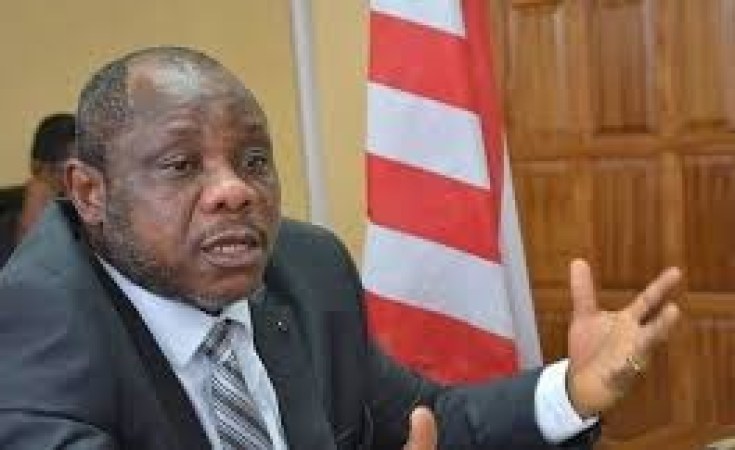
"Since the witch-hunt against my person, I have informed Liberians... that I was coming to face my accusers and vindicate my name," -- Samuel D. Tweah Jr.
True Justice vs. Legalism: In the Apology and Republic, Socrates indicates that true justice is not merely abiding by the law but acting in accordance with virtue and knowledge. A court that finds the truly innocent "not guilty" is acting justly.
Former President George Weah: I gave praise to the Lord... in reference to Samuel Tweah's acquittal," -- Report from Monrovia Latest News."
"The dramatic outcome has now triggered fierce public debate over what critics are calling a politically driven prosecution that consumed months of national attention but ultimately crumbled under the weight of weak evidence," -- FrontPageAfricaonline.com
Follow us on WhatsApp | LinkedIn for the latest headlines
Machiavellian View: Illustrates the necessary flexibility of the law, where the "effective truth" (realpolitik) of the case is more important than absolute moral righteousness.
"If there was a case but the evidence failed, fix the investigators. But don't drag the country through the mud. Let this be the last time we sacrifice national progress on the altar of political scores," -- Facebook comment.
"Justice in Liberia is dispensed selectively. Certain people go to jail if they are found guilty... while others are given freedom, even if the gravity of the crime warrants it," -- Frank Thomas, a Liberian.
"A very raw judicial system in our country... law enforcement in this country has been weaponized," -- Reaction to the verdict on Facebook.
Judicial Independence: The acquittal or dismissal of cases, such as those analyzed by the Department of Justice, represents a potential triumph of judicial independence over political pressure to convict.
António Guterres (UN Secretary-General): "When countries disregard the international laws they themselves have established, instability becomes contagious, conflicts spill over, and economic shocks reverberate around the world. The result is chaos."
Agnès Callamard (Secretary-General of Amnesty International): "Flagrant rule-breaking by governments and corporate actors... [shows] the very institutions set up to protect civilians and uphold human rights are no longer fit for purpose. "
Pope Francis: "Corruption is paid by the poor." This sentiment is frequently cited in cases of economic sabotage to illustrate that the true "sabotage" is the harm done to the most vulnerable citizens.
Robert H. Jackson (U.S. Supreme Court Justice & Nuremberg Prosecutor): "We do not ask for convictions unless we prove crime... planned and intended conduct that involves moral as well as legal wrong." His opening at Nuremberg established that even in massive state-level economic and social crimes, the prosecution must move beyond 'technical transgressions' to prove intent.
Cesare Beccaria (Criminologist): "No man can be judged a criminal until he is found guilty; nor can society take from him the public protection, until it has been proved that he has violated the conditions on which it was granted". This 18th-century principle continues to guide modern trials where the state attempts to bypass traditional rights in the name of
"national economic security."
By: Austin S Fallah - A True Son of the Planet Earth Soil: fallahas@yahoo.com.
In the labyrinth of judicial proceedings and the expansive corridors of justice, the truth has an uncanny ability to carve a path through seemingly insurmountable obstacles.
This rings particularly true in the case of Samuel D. Tweah, the former Minister of Finance and Development Planning in Liberia, who recently found himself embroiled in a highly publicized trial centered around economic sabotage.
This charge weighed heavily on not just his life and career but also on the broader implications for Liberia's judiciary and political landscape.
The jury's eventual decision to acquit Tweah on the grounds of innocence underscores a critical moment in Liberia's legal narrative, one that reverberates with the ideals of justice, truth, and democracy.
The backdrop of this case is one fraught with complexities. Liberia, with its long history of political and legal turmoil, has been grappling with a judiciary perceived as biased and inconsistent.
Citizens have long been wary of a system perceived as favoring those with political power over the principle of justice. However, the acquittal of former Finance and Development Planning Minister Samuel Tweah paints a different picture, one in which the judiciary may align with democratic ideals.
In this instance, the jury did not simply deliver a verdict based on evidence but rather reasserted the foundational tenet that innocence should triumph in the face of accusations lacking substantive proof.
The trial of former Minister Samuel Tweah, marked by intense scrutiny and high public stakes, provided the judicial system with a platform to demonstrate its commitment to fairness.
As the proceedings unfolded, spectators watched closely, not just as onlookers but as participants in a collective hope for a judiciary that serves the people rather than powerful interests.
When juries embody democratic tendencies, as witnessed in this case, they signal an allegiance to the truth that resonates deeply within the fabric of a society yearning for reconciliation and justice.
The jury's decision to return a non-guilty verdict against former Minister Tweah represents not only the triumph of an individual but also an assertion that truth, when pursued with integrity, can lead to substantial outcomes in the quest for fairness.
The implications of the verdict against former Finance and Development Planning Minister Samuel D. Tweah, Jr., extend far beyond the immediate relief felt by an acquitted minister.
They instigate critical discourse surrounding the legitimacy of Liberia's judicial processes.
For many, the ruling signifies a crucial turning point, a validation that the legal system can, under certain conditions, facilitate justice rather than obstruct it.
Such outcomes can foster renewed faith among citizens in their judiciary's capabilities, thereby empowering them to hold institutions accountable and to demand adherence to the rule of law.
It contributes to a collective consciousness that suggests the potential for a more equitable treatment under the law for all citizens, irrespective of status or power.
Additionally, the verdict against former Minister Samuel Tweah could alter the political landscape in Liberia.
The nature of the accusations, that he was charged with economic sabotage, is directly tied to overarching themes of governance, accountability, and stewardship of public funds.
When public figures can successfully refute such serious allegations, it calls into question the motives behind their prosecution.
Was the case, in essence, a politically charged maneuver aimed at discrediting a potential opponent or merely a reflection of systemic bias?
The not-guilty verdict allows for a narrative that characterizes the judiciary as a space resistant to political manipulation, thus fostering a more robust political environment where reform and progressive ideologies may flourish.
Moreover, the acquittal of Tweah serves as a hopeful lesson in the resilience of democratic institutions.
It highlights that while the machinery of justice can falter, with those in power sometimes taking advantage of vulnerable circumstances, the persistent pursuit of truth is an antidote.
This belief in the ultimate victory of truth resonates strongly in many democratic societies, where the judiciary serves as both a watchdog and a guardian of public interests.
The events surrounding Tweah's trial thus reaffirm the essential role of jurors, who embody civic responsibility and illustrate the collective conscience of a society committed to democratic principles.
In this context, it's important to acknowledge that justice does not always happen in predictable patterns.
The phrase "the truth shall always win" suggests an unwavering confidence in the legal processes, yet reality often dictates otherwise.
In Liberia's case, the judiciary's complicated history has led to numerous instances in which power dynamics skew outcomes.
The acquittal of former Minister Samuel Tweah feeds into the narrative that, though the system may have its flaws, justice can manifest in its truest form.
As Liberia continues to navigate its political and social complexities, the significance of this case should not be underestimated.
Former Finance and Development Planning Minister Samuel Tweah's victory is emblematic of a growing public realization that justice is vital to national unity and democratic stability.

Sign up for free AllAfrica Newsletters
Get the latest in African news delivered straight to your inbox
By addressing and overturning the narrative surrounding its judiciary, Liberia can work toward a system that prioritizes the innocent and fortifies citizens' trust in the rule of law.
This aspiration is not only beneficial for individuals but is also pivotal for broader societal cohesion.
Therefore, as Liberia reflects on the implications of the former Minister Samuel Tweah case, there lies a profound duty to learn from these events.
Legal reform and systemic adjustments can enhance the integrity of judicial processes, ensuring transparency and fairness.
Engaging citizens in discussions about their rights, the rule of law, and the importance of an unbiased judiciary will further promote a culture in which truth is sought and justice is served.
The case reveals that truth can emerge from the shadows of doubt, and indeed, the law can protect the innocent when society collectively demands it.
This pivotal moment encapsulates the hope that, through rigorous scrutiny and a commitment to democratic values, Liberia can better reshape its judicial system to reflect the principles of fairness and justice.
The innocence of Samuel Tweah serves as both a reminder and a clarion call to embrace truth, bolster trust in legal institutions, and cultivate a nurturing environment for political dialogue and reform.
While the verdict delivered in the Tanner case may be a singular event, it carries weight beyond its immediate boundaries.
The non-guilty verdict for former Minister Samuel Tweah stands as a beacon of hope and a testament to the resilience of truth in the face of adversity.
It is a call to action for all Liberians, underscoring the necessity of participating actively in sweeping reforms to ensure that future instances of injustice are met not with resignation but with the collective power of an informed, engaged citizenry.
May the legacy of this case inspire the nation towards greater unity and a renewed commitment to justice, for as the acquitted minister's journey illustrates, when the innocent face justice, victory for truth is within reach, and the essence of jurisprudence is revitalized.

