Just days ago, the United Nations voiced deep concern after Iran launched missile and drone attacks against the United Arab Emirates, injuring at least three people and sparking a fire at an oil facility in the Fujairah industrial zone.
At a press briefing, the Secretary-General’s spokesperson, Stéphane Dujarric, also warned of a series of recent strikes targeting vessels in and around the Strait of Hormuz, underscoring the risk of renewed hostilities amid a fragile ceasefire and mounting regional tensions. Against this backdrop of escalating instability in the Middle East, a key question emerges: can Africa continue to serve as a central pillar of Arab aid deployment and will economic engagement on the continent remain a strategic priority for Abu Dhabi?
In humanitarian circles, few UN diplomats or researchers have a clear grasp of the UAE’s foreign-aid strategy. That blind spot is striking, yet understandable. The Emirati approach does not fit the classical model of humanitarian action; rather than operating within the traditional Humanitarian–Development–Security nexus in vogue in New York, the UAE is charting a distinct course. Its unorthodox, hybrid model blends development diplomacy, economic projection, and geopolitical stabilization—with Africa emerging as a central testing ground since the COVID-19 pandemic.
Instead of treating assistance as charity, the UAE increasingly frames it as a lever for long-term transformation to finance infrastructure, enable investment and support the emergence of new urban and economic hubs. The implication is a quiet but significant shift for the humanitarian space: away from aid as short-term relief, and towards “smart development” strategies aimed at reducing structural dependency on traditional aid models. Yet this strategic reframing raises a fundamental question: does this model genuinely transform development outcomes on the ground, or does it risk reshaping aid into a vehicle for influence where economic and geopolitical priorities ultimately outweigh humanitarian principles?
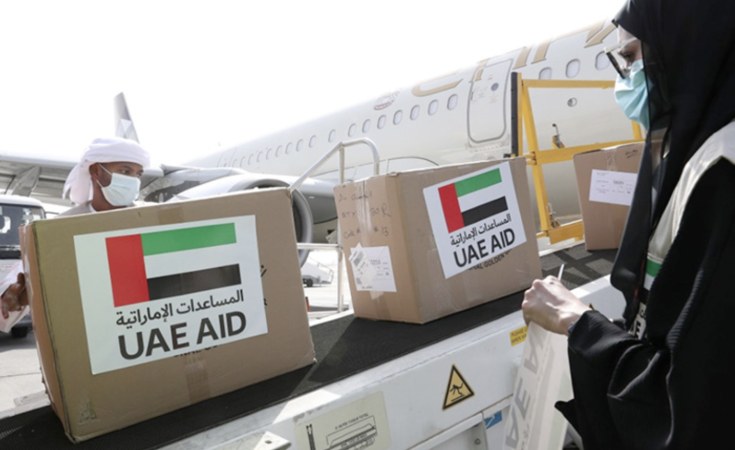
Since its founding in 1971, the United Arab Emirates has disbursed nearly $88bn in foreign assistance, reaching more than 1bn people worldwide. Far from slowing, this effort continues to expand as illustrated by its recent $1.5m contribution to the UN’s human-rights office. Relative to the size of its gross national income, the UAE ranks among the most generous donors globally, often outpacing OECD member states. But what sets the Emirati model apart is its structure and one can explain the functioning of such model with three key figures. First, at least 15% of total aid is earmarked for humanitarian assistance, anchoring its role as a rapid responder to emergency crises.
Second, more than 80% of its aid between 2017 and 2021 was directed towards Asia and Africa, reflecting a clear geographic prioritization of high-growth and high-need regions. Third, its efforts are concentrated across seven strategic sectors: infrastructure, health, education, climate, food security, gender, and technology. This strategic focus is supported by an extensive operational ecosystem which consists of more than 45 Emirati donor institutions delivering aid and coordinating a complex network of agencies. At its core sits Dubai’s International Humanitarian City, now the world’s largest logistics hub for humanitarian assistance.
In Africa, the approach reflects a blunt assessment of the region’s reality: no country and especially post-Covid can escape poverty or hunger through aid alone. Also, the existence of 16 landlocked countries generates a cruel need for connectivity and development of roads, ports, and energy systems. The logic is not only to improve livelihoods, education and access to health, but doing all that by also enable commerce and creating the conditions for sustained economic exchange and ultimately offering Dubai new economic partners.
African peoples require just that agility, one that integrated to the aid algorithms a real integration into global markets and commerce. Real development and foreign assistance are this way used to unlock trade, de-risk investment and build what Emirati officials now call a “gateway to Africa’s prosperity”. Beyond the optimism, the sustainability of such approach can only survive if trust is implemented between the civilians and Emirati donors who vow to present their assistance as unconditional and untied to political alignment, religion or even governance models.
More recently, investments in African infrastructure (often in partnership with development banks) serve dual purposes: accelerating local growth while anchoring Emirati firms in strategic sectors. In a continent where infrastructure financing gaps run into tens of billions of dollars annually, this creates significant leverage. Food security is another driver. The UAE, with limited arable land, sees Africa as a future supplier. Investments in agriculture, supply chains and climate-resilient farming are designed to boost productivity while securing long-term access to food resources. Between 2017 and 2020 alone, the UAE committed over $1bn to food-security initiatives.
Finally, gender-focused initiatives are particularly prominent, reflecting a belief that women’s economic participation is a powerful driver of growth. For example, the country supports the Women Entrepreneurs Finance Initiative (We-Fi) to provide access to capital & AI digital training for women-led SMEs. To note that women in Africa make up to 60% of the agricultural workforce and providing them data-driven farming tools simply means transforming their lives for the better. These types of initiatives help integrate women into value chains and support entrepreneurship using a new development formula: combing gender equality with frontier tech.
Therefore, for the broader international system, the rise of Emirati aid signals a shift in Africa. Development finance is no longer the preserve of Western donors and multilateral institutions and we now see more funding about smarter integration of technology, finance and human capabilities. Middle powers, armed with capital and strategic ambition, are now reshaping the humanitarian landscape.
Yet this multifaceted engagement also invites a more probing question: to what extent do these investments genuinely build locally owned, inclusive economic systems and where might they instead entrench new forms of dependency, shaped as much by external strategic interests as by development outcomes?


