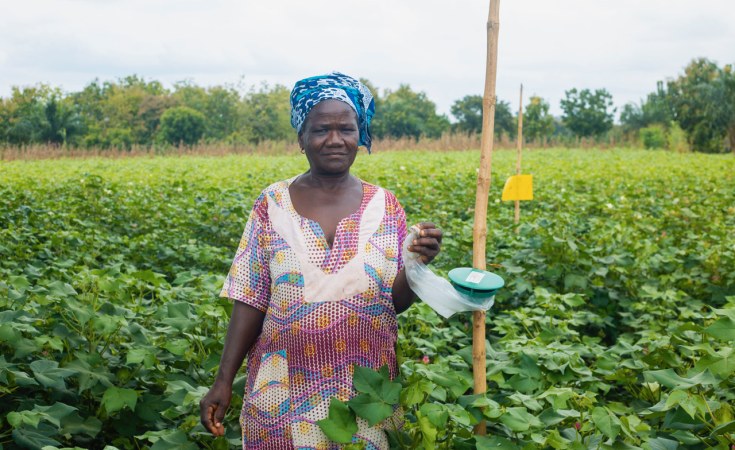
Cotton farmers in Togo are rebuilding their soils, reporting higher yields and reducing pesticide applications as regenerative practices take root. Farmer field schools are spreading the skills, helping growers strengthen cotton production and support the food crops their households depend on.
On her cotton farm in Bagbé, Togo, Badakizi Yawa is changing how she tackles pests. After training at a farmer field school, she began using pheromone traps and coloured sticky traps to monitor insects that damage cotton flowers and bolls.
She says the approach has reduced the number of crop protection treatments needed on her eight hectares.
“Previously, we sometimes carried out seven or eight treatments against pests, including insects. With these new traps, we now carry out three or four treatments,” she explains.
Keep up with the latest headlines on WhatsApp | LinkedIn
Yawa is among the farmers adopting regenerative practices promoted by the Nouvelle Société Cotonnière du Togo (NSCT). The approach combines soil conservation, organic fertilisers and more targeted pest control to address degraded land, irregular rainfall and rising production costs.
Introduced by NSCT in 2023, the programme seeks to restore the productive capacity of farmland while strengthening farmers’ livelihoods. Cotton, known as “white gold”, is a source of income for tens of thousands of farming households in Togo and accounts for approximately 20 per cent of export earnings, according to Kossi Assogbavi, NSCT head of communication department. The sector counted nearly 79,000 growers in the 2024–25 season, while raw cotton exports earned US$50.2 million in 2024 according to the World Bank.
“Progressive soil degradation is one of the main challenges facing cotton production in Togo today. And degraded soil means low agricultural yields,” explains Bissang Badating, an agronomist and NSCT’s head of agricultural projects and sustainability.
According to the company’s then managing director, Martin Drevon, average cotton yields rose from 570 kilogrammes per hectare four years ago to more than one tonne during the 2025–2026 agricultural season. He attributes the increase to a combination of traditional farming knowledge, regenerative techniques and NSCT’s support.
Some producers working through farmer field schools have recorded yields of between 1.4 and two tonnes per hectare, the company reports. Results vary, however, and the gains do not establish how much of the increase comes from regenerative practices alone.
Restoring the soil
The practices being promoted include zero tillage, crop rotation, intercropping, erosion control and the integration of crop farming with livestock rearing. Farmers also learn to produce and use biochar and bokashi as soil amendments.
“Regenerative agriculture is not simply one option among many. It is a response aimed at restoring the health and fertility of our soils, strengthening the resilience of farms and safeguarding our farmers’ livelihoods,” Drevon says.
Zero tillage avoids routinely turning the soil before sowing, helping preserve its structure and retain moisture. Crop rotation involves growing different crops successively on the same plot to support soil fertility and disrupt some pest cycles.
The programme adapts these practices to local conditions. In southern Togo, where cotton and maize are already grown together, it supports systems suited to that combination. In northern areas, integrating crop and livestock farming forms part of the approach.
For pest control, farmers use traps to monitor insects and guide decisions about when treatment is needed.
With technical and financial assistance from Olam Agri, NSCT has trained technicians to support farmers. During the 2025–2026 agricultural season, it deployed 40 farmer field schools where producers could observe techniques, compare results and exchange knowledge.
Learning in the fields
Douti Damessona, chairman of a cotton farmers’ group in Assoumakope, reports yields above two tonnes per hectare.
“During the 2025–2026 agricultural season, we harvested 188 tonnes of seed cotton from 88 hectares, achieving a yield of more than two tonnes per hectare. For the new season, we have increased our cultivated area to 100 hectares,” he says.
His group’s results illustrate the potential, although they do not represent outcomes across all farms.
According to NSCT, more than 37,000 farmers have received training in zero tillage, with over 60 per cent applying it. Another 36,650 have been trained in crop rotation, for which the company reports a 97 per cent adoption rate. These groups may overlap.
A further 1,352 farmers have received training in producing and using biochar and bokashi, while 714 have been trained in erosion control. During the 2025–2026 season, the activities supported the production of more than 27 tonnes of biochar and 24 tonnes of bokashi.
“The techniques I have learnt have helped me better control water run-off and soil erosion. They also enable me to produce organic fertiliser. This is a real relief for us farmers,” Damessona says.
Turning yields into income
For producers, the value of the transition depends on whether better harvests and changes in input use translate into higher earnings.
Yawa says fewer pest treatments have reduced her use of crop protection products. She has also observed benefits from biochar and bokashi, which she says help retain soil moisture and support the growth of cotton and maize.
Her ambition is to achieve two tonnes of cotton per hectare, provided conditions are favourable and she develops sufficient mastery of the techniques.
Because many cotton-growing households also cultivate food crops, improvements in soil fertility could support both farm income and household food supplies. But the financial benefits need to account for the labour, materials and time required to adopt the practices.

Sign up for free AllAfrica Newsletters
Get the latest in African news delivered straight to your inbox
Barriers to adoption
Research involving NSCT, the University of Lomé and the University of Essex is examining how to expand regenerative agriculture in Togo’s cotton sector. An initial survey in 2024 found that some farmers were already using practices such as crop rotation and integrated pest management to respond to rainfall variability, improve soil health and preserve biodiversity. The collaboration aims to build on these practices through training, support and farmer participation.
Water shortages present another difficulty, particularly for producing soil amendments during the dry season. NSCT says farmers have been trained in a technique that reduces the water needed to extinguish fires during biochar production.
Land tenure is a further concern. Farmers uncertain about their future access to a plot may be reluctant to invest in soil restoration whose benefits accumulate over several years.
Despite these constraints, Badating says the field results are encouraging.
“The results we are achieving in the field clearly demonstrate that regenerative agriculture practices are more beneficial to soils and rural communities in general,” he says.
For Yawa, the next test is whether fewer pest treatments and healthier soils can help her reach her yield target—and improve the returns from the land she cultivates.
