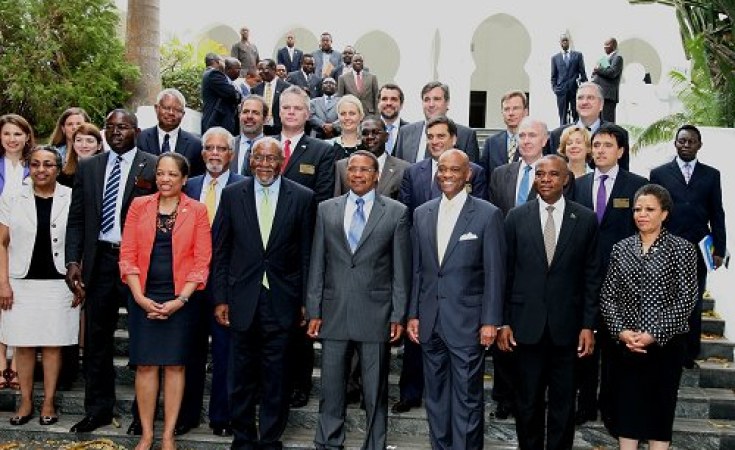
"American influence and dominance in Africa has been significantly eroded by China, Brazil, India and others," Mwangi S. Kimenyi, director of the Africa Growth Initiative at The Brookings Institution, wrote in a recent article that took a generally positive view of Africa policy under President Barack Obama. One area where commentators say American endeavors are lagging is economic engagement. In the third and final part of an AllAfrica interview, the chief U.S. Africa policymaker, Assistant Secretary of State Johnnie Carson, described the administration's efforts to encourage U.S. firms to recognize opportunities and ways he believes economic growth can alleviate Africa's widespread poverty.
Support for economic development has to compete for high-level attention with other stated policy priorities and the need to respond to ongoing and urgent crises. How do you assess your record in this area?
This administration is committed to promoting economic growth and investment, increased trade with Africa and greater trade between African countries. This is one of the five pillars of our policy.
I would be the first to say we're not doing enough. We need to be doing more to encourage more American companies to take a look at the potential that exists. We have been working hard to open doors to government ministries and to introduce them to private sector colleagues. We're working to lower the level of misinformation and apprehension and address concerns that they have. We are working to introduce [companies] to a continent that we think is going to be a leader moving forward across this century.
Keep up with the latest headlines on WhatsApp | LinkedIn
We really do focus on this. Just two weeks ago, the Secretary [Hillary Clinton] hosted some 300 business leaders from across the U.S. and from around the world - a large group of them from Africa, from chambers of commerce and business associations across Africa - to make it clear that the U.S. government is interested in trade promotion and in economic growth through business and private sector-led efforts.
The African Growth and Opportunity Act, which was passed by Congress in 2000 was a policy centerpiece during the two previous administrations - Clinton and Bush. How does it fit into your agenda?
We have worked hard to sustain the good work under Agoa, which remains the main trade pillar for U.S. relations with Africa. Secretary Clinton has participated in three Agoa meetings. In 2009 she led the delegation to Kenya, along with Secretary of Agriculture [Tom] Vilsak. In 2010, when the Agoa forum was here in the United States, the Secretary was the principal speaker, along with Ambassador Ron Cook [the U.S. Trade Representative] and Secretary of Transportation Ray La Hood.
We did something novel in 2010. After a policy forum here in Washington, we took Agoa delegations (from Africa) to Kansas City to introduce them to the whole range of American agriculture - from seed production, fertilizer and water systems, and cropping methods - all the way to the agro-industry that makes our agriculture strong. In 2011 Secretary Clinton led our delegation to the Agoa forum in Zambia, along with Ambassador Cook.
Secretary Clinton is again co-hosting the forum here this summer, and we are looking forward to having an infrastructure and energy-related follow-on meeting in Cincinnati in which we hope many of those participants in the Agoa forum will take part. These activities are emblematic of our commitment to trade and investment issues.
We work closely with the Corporate Council on Africa, with Steve Hayes and Ambassador Bob Perry, to bring U.S. government weight alongside that of trade organizations to promote increased trade and investment in Africa.
It is also important for us to encourage African governments to undertake the policy reforms and create the kind of economic and commercial environment that will make them attractive to businesses. By doing both of those things we can make progress.
What was the purpose of the energy trade mission that you led last month?
We took 10 American energy companies to five African countries looking to grow the distribution of electrical power to their factories, to their cities, to their schools and to their hospitals. Some [of the companies] were large and familiar with Africa, and some were medium-sized or small. Some had never been to Africa before.
We visited Mozambique, which has enormous hydro-electric potential and shows great promise, not only for being able to supply power to its own citizens but also to the southern African regional power pool. They are thinking about expanding the Cahora Bassa dam, which supplies mostly power to South Africa - to virtually double its size by creating a new spillway and a new set of generators on the north side. They're also thinking about building another dam nearly as large.
We went to Tanzania, which has recently discovered huge gas deposits in the southern part of its maritime domain that can be used not only to meet the country's energy needs but also to export to other parts of southern and east Africa.
We also went to Nigeria, Africa's largest oil producer at 2.2-million barrels a day, which has enormous energy potential, but also enormous energy needs. We went finally to Ghana, [where] a new oil industry came on stream last year. We also stopped in Kenya, which is doing innovative things in geo-thermal and wind and in solar.
We were joined by representatives from U.S. government agencies that help to assist American investment overseas - the Export-Import Bank and the U.S. Trade and Development Authority, which provides a great deal of funding for feasibility studies. And we had the support of the Overseas Private Investment Corporation.
I led the delegation on part of the trip, and one of my deputies took over on the last two stops, Nigeria and Ghana. The trip was part of a sequenced focus on energy and energy needs in Africa. The Corporate Council on Africa, in October of 2011, when it had its major conference here in Washington, had a focus on African energy needs. They invited ministers of energy and industry from Africa to talk about their energy needs and their desire for investment, and it was from that conference that we began to develop our trade mission, identifying companies and identifying countries where there might be synergies and partnerships.
We have been able to build some strong linkages.
Are you broadening the work with American companies from agriculture and energy to other sectors?
We will continue to focus on specific areas where we think American companies have comparative advantage and where American companies can bring skill, technology and resources to help Africa deal with some of its challenges. We will continue to focus on energy, and on infrastructure, and we will come back to agriculture and water again where we think that there are real possibilities for investment.
We believe Africa is the last global economic frontier. The continent has enormous promise and potential - much of which we are starting to see right now. The World Bank reports that seven of the 10 fastest-growing economies in the world are in Africa. In the last decade Africa has experienced economic growth of 5.7-5.8 percent a year, second only to Asia. It is important that we do as much as we can to encourage American companies to look at the enormous potential and opportunity that exists on the continent - and to take advantage of it.
You credit trade and investment promotion with helping to spark Africa's high-growth rates. What are the prospects for improving the lives of the continent's impoverished majorities?
Rapid growth has to be driven by private investors, both domestically generated and investment that comes in from outside. Africa cannot make progress based simply on development assistance aid. Investment can develop economies in such a way that jobs are produced, skills are developed, products are produced, and money is earned - not only for workers, but also for taxes, for government to deliver services that people need.
Growing the agricultural sector, growing the energy sector, growing the industrial IT sectors, are the ways to go. Agriculture is a case in point. Some 70 percent of all African households today are dependent primarily or secondarily on agriculture as their primary source of economic livelihood.

Sign up for free AllAfrica Newsletters
Get the latest in African news delivered straight to your inbox
Strengthening Africa's agriculture can end starvation and hunger and famine at the household and village level but it can also create large opportunities for the export and manufacture of agricultural products through an agro-industry that feeds not only Africa but other parts of the world as well. Agriculture in Africa is probably the least productive in the world. African farmers use the poorest quality seed and the least amount of fertilizer. They are heavily dependent upon rain and get the smallest crop yields.
This does not have to happen in 2012, and we are determined through our Feed the Future program, working with a number of African presidents and governments, to help generate in Africa the kind of green agricultural revolution that in the late 60s and early 70s effectively transformed agriculture in places like Brazil and India into first class agricultural producers.
There's no reason why Nigeria should spend several billion dollars a year on rice imports. There is no reason why a country with as fertile a soil as Angola should import any food, any grain, any wheat, any maize.
And there is really no reason why Tanzania or Ethiopia can't feed other parts of the world that don't have the same kind of soils [and] long, warm summers.
Creating a green revolution is a part of the transformation. Equally is energy. Africa is a major producer of petroleum and gas. But everyone has [seen] the NASA photo of the globe of the world at night [with] every continent lit up - with the exception of Antarctica and Africa.
That should not be. The United States imports just about the same amount of oil from Nigeria as it does from Saudi Arabia.
Africa not only has tremendous oil and gas. It also has tremendous potential for solar, for wind and for hydro. This is power that should be harnessed for development. There is no reason why Africa can't have greater generation and distribution of electrical power.

