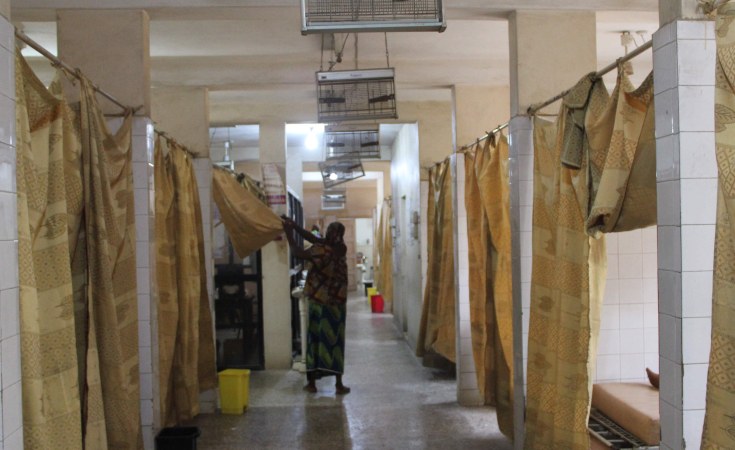
A frail, pale and breathless woman was bleeding profusely during childbirth at the make-shift maternity ward of Primary Health Care (PHC) centre Dogon Dawa in Kaduna State, Nigeria.
Our trip was part of a routine assessment visit of the healthcare facilities that are supported by the UK Department for International Development-funded Partnership for Transforming Health Systems Phase II (PATHS2), whose aim is to reduce maternal mortality in its five focal states of Jigawa, Kaduna, Kano, Enugu and Lagos.
One of the healthcare workers on duty revealed that the woman giving birth had bled for a long time at home because, amongst other reasons, she could not afford the transport to the facility.
Rural woes
This scenario is all too common in northern Nigeria where maternal mortality rates are very high. Transport might be taken for granted in many countries around the world, but in Nigeria it remains a significant cause of maternal mortality.
But if women are to lead the fulfilled lives they deserve, then protecting their health and wellbeing, particularly through their years of bearing children, is essential. In Nigeria, pregnancy and childbearing is a dangerous business, especially for poorer women.
Africa's most populous nation also has one of its highest maternal mortality rates, at 545 per 100,000 live births. In the poorer northern states, this figure rises to as high as 1,100 per 100,000.
One of the key reasons for this appallingly elevated rate is the fact that Nigeria's northern states have largely rural populations, with many women living many miles away from their nearest health centre and access to emergency professional healthcare. Poor road networks and a poorly-organised and resourced ambulance service merely serve to exacerbate the problem.
Fare play
However, thanks to a unique initiative launched in 2012 by PATHS2 which has brought rural communities and Nigeria's powerful transport unions together, thousands of pregnant women's lives are being saved.
The scheme is working in partnership with the Nigerian government and other stakeholders to improve the planning, financing and delivery of sustainable health services for those most in need, particularly poor women and children.
In addition to this work at federal level, PATHS2 works in five focal states, including Kaduna, Kano and Jigawa in the less-affluent north of Nigeria. It is in these three states that the innovative Emergency Transport Scheme (ETS) is being implemented.
The scheme cooperates with Nigeria's powerful and well-organised transport union to use taxi drivers as volunteer ambulance drivers, using their own vehicles to get pregnant women to a hospital or clinic during an obstetric emergency.
Under the Emergency Transport Scheme, taxi drivers are given training on safe driving practice and on understanding the danger signs in pregnancy. This helps them to keep women calm and safe during the trip, which is often hastily arranged after a panicked midnight call to the driver's mobile phone.
In return, drivers who volunteer get special privileges in their day jobs, such as being promoted to the front of taxi ranks by union supervisors. Stickers for taxis are also provided, which identify their status as Emergency Transport Scheme members, and there's also special headlight signalling which enables soldiers guarding checkpoints on dangerous roads that are subject to curfew to recognise them.
Moving up the ranks
Since its inception in 2012, the Emergency Transport Scheme has helped over 2,274 women to receive timely medical help, which has probably saved their lives and the lives of their new-born children.
Talatu Sale of Jigawa State is one of the women it has helped. Sale went into labour in the middle of the night, and began bleeding. Her husband called the Emergency Transport Scheme driver. He arrived 20 minutes later and rushed her to Hadejia General Hospital:

Sign up for free AllAfrica Newsletters
Get the latest in African news delivered straight to your inbox
"The midwife gave me an injection that stopped the bleeding", says Sale. "If not for the ETS, I might have lost my life and my baby."
The scheme has also attracted support from senior government levels - a wife of the former governor of Kaduna State is a huge supporter of the initiative. Other states in Nigeria are looking to replicate the system in their own jurisdictions, having witnessed just how effective it can be in saving women's lives.
I believe that we can make the scheme even stronger by getting government to support its roll-out across the entire nation. The current plan in Kaduna and Kano states, where the scheme was launched last year, is for the scheme to be rolled out across the whole nation - which the Kano state governor has committed to achieving.
Samuel Usman works as a service integration advisor at PATHS2.

