
Washington, DC — The Africa Bureau at the State Department has a new top official, Nick Checker. Unlike his recent predecessors who were career diplomats, he has been at State for only four months, having served for the previous decade as a military analyst at the Central Intelligence Agency (CIA). He spent part of 2025 working in the White House as deputy executive secretary on the National Security Council (NSC) staff.
African developments are mostly overshadowed by highly publicized crises in other regions, including the world's worst humanitarian emergency in Sudan. But Africa's vast untapped resources and ongoing brutal conflicts promise to keep American policymakers engaged during 2026..
Checker replaces Jonathan Pratt as Senior Bureau Official, the Department announced in a post on X. A former U.S. Ambassador to Djibouti, Pratt had been in the post since July, when he succeeded Troy Fitrell, who was serving as U.S. Ambassador to Guinea when he was named to the position shortly after President Trump took office last January.
As Senior Bureau Official - the designation the administration is using for acting positions in many agencies - Checker is charged with managing day-to-day relations with 49 countries in west, east, central and southern Africa. Algeria, Egypt, Libya and Tunisia are assigned to the Bureau of Near Eastern Affairs.
Africa's strategic geopolitical position, as well as its vast resources, promise to keep American policymakers engaged.
At the CIA, Checker focused on "conflicts in the greater Middle East and Horn of Africa", according to his State Department bio. He spent one year as a national security fellow in the office of Senator Bill Hagerty, a Republican from Tennessee. At the beginning of Trump's term, Checker moved to the CIA's Congressional Affairs office, where "he supported the confirmation process for Director John Ratcliffe," according to a press release from Hagerty's office. At the National Security Council, Checker provided "senior-level review of NSC products for substance, policy relevance, and appropriateness," the Hagerty release said.
The President's unorthodox approach to foreign policy - using Truth Social posts as a primary communication channel and sidelining experienced diplomats - has devolved much of U.S. high-visibility diplomacy involving Africa to the President's chosen envoy, Massad Boulos – and Trump himself. Most recently, Boulos engineered the signing ceremony for a peace accord he mediated between the Democratic Republic of the Congo (DR Congo) and Rwanda. Trump hosted the ceremony at the U.S. Institute of Peace, renamed in December by the State Department as the Donald J. Trump Institute of Peace.
Before his appointment as U.S. Senior Advisor for Arab and African Affairs, Boulos - whose son is married to the President's daughter Tiffany - ran a truck and heavy machinery dealership in Nigeria. His globe-trotting and episodic engagements over the past year have ranged from meetings last week with top officials in Yemen and Saudi Arabia to negotiating with rival factions in Libya and spearheading the 'Quads' initiative involving Egypt, Saudi Arabia and the UAE that produced a proposed roadmap to end fighting in Sudan.

Sudanese civil society groups, often in the middle of battles, provide what limited food and medical care is available in many areas – primarily from contributions by Sudanese abroad. Those still trapped inside, or who moved abroad, protest that no peace accord will be durable without the participation of professionals, farmers, women's groups and workers whose campaigns led to the ouster of the former dictatorship.
READ: Endless Conflicts, Boundless Courage Shape Sudan's Past, Present
Pursuing deals and resources
In May the Trump administration unveiled its commercial diplomacy strategy, prioritizing access to rare earths and other critical minerals and promoting business opportunities for U.S. companies. The objective, now-retired State official Fitrell said in his announcement, is "to increase U.S. exports and investment in Africa, eliminate our trade deficits and drive mutual prosperity." He said American ambassadors in the region were tasked to "go out and find commercial opportunities" and "to find opportunities to advocate for American companies."
A litany of other administration policy shifts have resulted in major disruptions across Africa:
- dismantling of USAID and drastic cuts in foreign assistance shuttered HIV/Aids clinics, disrupted drug supplies and disrupted vital health research;
- imposition of huge tariffs have strained national budgets and reduced trade; and
- immigration and travel bans have made Africa the most restricted region in the world, with nationals from 36 of Africa's 54 countries subject to visa constraints – 12 barred from receiving most visas and 24 facing heightened scrutiny, limited visa category eligibility or mandatory financial visa bonds ($5,000 - $15,000).
Since the launch in September of the America First Global Health Strategy, the administration's signature health initiative, the State Department has signed bilateral agreements with 13 governments – all in sub-Sahara Africa: Eswatini, Kenya, Liberia, Mozambique, Nigeria, Rwanda, Uganda and Lesotho, Botswana, Madagascar, Sierra Leone, and Ethiopia and, most recently, Côte d'Ivoire.
Citing data privacy concerns, the High Court in Kenya last month suspended the agreement that President William Ruto signed in Washington, DC on December 4th, after critics raised concerns that personal health information would be shared with private-sector pharmaceutical firms and laboratories and with tech and cloud-storage companies. Independent health consultant Yirgalem Addisu, writing in the Addis Standard, called for "a sober assessment of trade-offs" in Ethiopia's pact with the U.S. government, to determine if Ethiopian interests are served by the "extensive data sharing, integration of health surveillance systems, and adherence to strict performance benchmarks," or whether it should be reexamined.
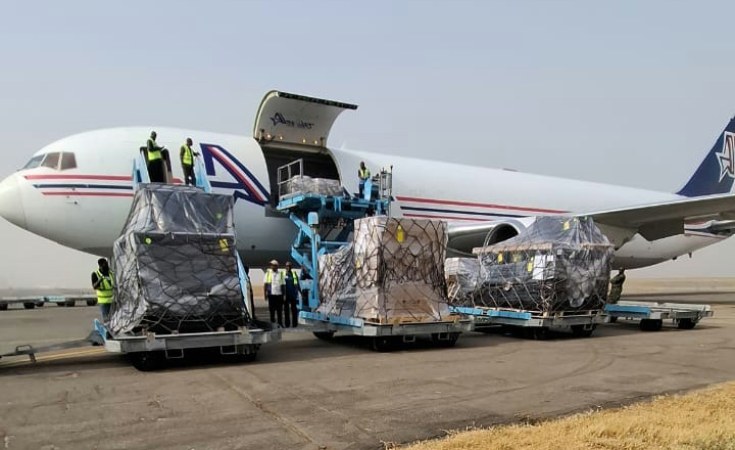
Trade and investment, backed by military force and presidential interventions, is replacing conventional diplomacy in U.S. Africa policy.
Trump's personal engagement with Africa's leaders has included two publicized Oval Office sessions. The first was with Cyril Ramaphosa in May, when the South African president was lambasted by false charges of white genocide in his country. In July, the American president hosted five leaders from coastal Sahelian nations - Joseph Nyuma Boakai of Liberia, Bassirou Diomaye Faye of Senegal, Brice Clotaire Oligui Nguema of Gabon, Mohamed Ould Ghazouani of Mauritania, and Umaro Sissoco Embaló of Guinea-Bissau, where Trump spoke about the "incredible commercial opportunities" that could move relations "from aid to trade".
During the DR Congo-Rwanda signing ceremony last month, Trump singled out the importance of the valuable resources in the area and announced "bilateral agreements with the Congo and Rwanda to "unlock new opportunities for the United States to access critical minerals and provide economic benefits for everybody," including "some of our biggest and greatest companies."
Trump team is leveraging deals to halt the fighting in eastern DRC.
Boulos has sought to leverage the prospect of lucrative contracts and American private sector involvement to convince the warring parties to halt the killing. In addition to last month's peace accord, DR Congo and Rwanda signed an extensive Regional Economic Integration Framework that links peace to shared economic prosperity by securing mineral supply chains, promoting cross-border infrastructure connectivity (roads, railways and energy), enhancing collaboration for disease prevention and sustainable tourism, and encouraging U.S. investment to raise the "opportunity cost" of wartime profiteering.
Today, 12 January, the DR Congo state-owned mining company Gecamines announced the first shipment of copper to the United States through its partnership with Mercuria Energy Group, a Swiss-based commodities broker – part of a deal Boulos has been promoting. The company will supply 100,000 tons from the giant Tenke Fungurume mining project, Bloomberg's Michael J Kavanagh reported. Congo supplies about two-thirds of the world's cobalt and is the second-largest supplier of copper – minerals vital for production of lithium batteries used in electric vehicles and for the data centers that are required for AI.
But the reliance on dealing-making has yet to produce the desired outcome. The latest advance of M23 has boosted its already extensive control over valuable mineral resources in eastern Congo, many of which are believed by many analysts to end up in Rwanda. M23 says it is providing protection for Congolese Tutsis from the FLDR (Democratic Forces for the Liberation of Rwanda), which has ties to perpetrators of the Rwandan genocide against Tutsis in 1994.

Meanwhile, the Congolese women's rights organization SOFEPADI and Human Rights Watch said on 12 January that conflict-related "sexual violence in eastern DRC has escalated, while support to survivors has significantly dropped."
Some five million people have been displaced by recent fighting in the eastern DRC's provinces of North Kivu, South Kivu and Ituri, according to the UN Refugee agency. Every month brings reports of violence that Congolese thought couldn't get worse.
Nobel Peace Prize laureate Dr. Denis Mukwege, a pastor from eastern Congo and a world expert on repairing fistulas, often a result of rape by armed factions, still operates a clinic supported by the Panzi Foundation and Hospital in Bukavu, a provincial capital in eastern DRC on the Rwandan border. Despite armed attacks, at one point being taken prisoner with his family, the work continues. The Panzi website notes that the DRC has U.S. $24 trillion in untapped mineral resources.
Africa – mineral-rich but 'on the periphery' diplomatically as embassies are downgraded
Securing access to vital resources is highlighted as a top administration priority in the National Security Strategy (NSS) issued by the White House last month. "This will require expanding American access to critical minerals and materials," says the document, which is a Congressionally mandated report, issued by every President since 1987, outlining Executive Branch assessment of global threats and a broad approach to safeguarding U.S. interests.
"The United States should transition from an aid-focused relationship with Africa to a trade- and investment-focused relationship, favoring partnerships with capable, reliable states committed to opening their markets to U.S. goods and services," the NSS states, in an echo of the Commercial Strategy issued in April. The 'Africa' strategy is laid out in a scant 210 words at the end of the 33-page NSS document.
The 2025 NSS report "gives little attention to Africa," mainly identifying it as a source of natural resources," Council on Foreign Relations editors stated in a 5 December briefing on the Council's website day after the NSS document was issued.
Confining Africa to the periphery, foreign policy analysts Christopher Faulkner and Raphael Parens argue, "risks deferring engagement, ensuring that future interventions, when they become unavoidable, are costlier and less effective." Nevertheless, the emphasis on "U.S. access to critical resources, including minerals and rare earth elements" elevates Africa's importance among administration officials.
"Africa is home to significant reserves of critical energy transition minerals such as 55% of cobalt, 47.65% of manganese, 21.6% of natural graphite, 5.9% of copper, 5.6% of nickel, 1% of lithium, and 0.6% of iron ore globally," according to the United Nations Economic Commission for Africa, citing statistics compiled by UNCTAD.

2025 saw a rapid rise in U.S. military operations including Somalia, Nigeria and the Sahel region.
Although the NSS includes only a one-sentence mention of "resurgent Islamist terrorist activity in parts of Africa", it cites a need to "remain wary" while "avoiding any long-term American presence or commitments". Last year saw a rapid rise in U.S. military operations in both east and west Africa. "Trump has presided over an unprecedented escalation of the U.S. counterterrorism war in Somalia," according to the New America Foundation, which tracks American military actions in several countries. The Foundation says there have been 128 U.S. air, drone, and ground operations in Somalia since January 2025 – the most in any year since covert action began there in 2003. (see chart).
The most publicized U.S. military undertaking in Africa last year was the Christmas Day bombing aimed at camps in Nigeria said to be linked to Islamic State-aligned militants. Trump described the action as "a powerful and deadly strike against ISIS Terrorist Scum" who he said, "have been targeting and viciously killing, primarily, innocent Christians at levels not seen for many years, and even Centuries!" Subsequent reporting has raised questions about the effectiveness of the strike, and four unexploded missiles -believed to have been among 16 Tomahawk warheads launched from MQ-9 Reaper drones fired from a U.S. Navy guided missile destroyer in the Gulf of Guinea - have been found by local residents and Nigerian police.
Additional attacks may be coming, Trump warned last week. "I'd love to make it a one-time strike,'' he told the New York Times. ''But if they continue to kill Christians,'' he continued, ''it will be a many-time strike.'' He also conceded, when asked, that Muslims are also being killed, "But it's mostly Christians."
More than three months earlier, speaking to reporters in Rome after meeting with Nigerian President Bola Tinubu, Trump advisor Boulos, questioned about Senator Ted Cruz's claims that Christians were being targeted in Nigeria, characterized that assertion as "unfortunate and misleading". He said insecurity affects all Nigerians and is not driven by religion. "Those who know the terrain well know that terrorism has no colour, no religion and no tribe… We even know that Boko Haram and ISIS are killing more Muslims than Christians." He said Nigerian religious groups had lived in harmony for centuries. "The population is split 50-50 between Christians and Muslims, so this has never been a serious religious issue and should not be," he said. Nigerian and international experts in peacebuilding policy have long said that, in addition to terrorism against both Muslims and Christians in the north, much of the violence across central Nigeria stems from a competition for scarce resources between farmers and herders, worsened by spreading deserts and disappearing water sources, markers of climate change.

A similar pattern in intensified terrorist attacks on civilians, many in Muslim countries across the continent, suggests that more U.S. military operations might be expected this year. "Fatalities linked to militant Islamist groups in Africa over the past year sustain a record level of lethality observed since 2023 and represent a 60-percent increase from the 2020-2022 period," according to the African Center for Strategic Studies, a Pentagon-affiliated research institution funded by Congress. The figures include the Sahel region in west Africa, Somalia and Mozambique, and the Lake Chad Basin (Nigeria, Niger, Chad, Cameroon, and the Central African Republic).
Vacant ambassadorships across Africa
As Checker moved into his sixth floor office on January 6th, senior-level foreign service officers serving in 15 African posts were packing to leave, following the late December recall of an unprecedented number of U.S. ambassadors, with Africa the most affected region. The Bureau that Checker now leads at State was chronically understaffed even before the latest recalls. The administration's drastic staffing reductions over the past year have reduced most U.S. diplomatic missions on the continent.
In his second term, Trump has submitted only four nominations for Africa posts. The first two were sent to the Senate in March and confirmed in October - Richard Buchan III (Morocco), a financier who served as Ambassador to Spain during Trump's first term and then became finance chair of the Republican National Committee; and Bill Bazzi (Tunisia), a Lebanese-American who, as mayor of Dearborn Heights, Michigan, campaigned for Trump in the 2025 election.
Joseph Giordano was confirmed in October as ambassador to Namibia following his removal as United States attorney for the District of New Jersey in March. Trump's choice for South African ambassador, conversative media critic Leo Brent Bozell III, won Senate approval on December 18, and was sworn in by Republican Senator Ted Cruz on January 8. He heads to South Africa to present his credentials to Ramaphosa and fill the position that has not had a confirmed chief-of-mission since President Biden's appointee, Reuben Brigety, departed a year ago.
Across Africa, 17 U.S. embassies have full-fledged ambassadors, 35 are without.
The 15 ambassadors who were recalled were serving in Algeria, Burundi, Cameroon, Cape Verde, Egypt, Gabon, Côte d'Ivoire, Madagascar, Mauritius, Niger, Nigeria, Rwanda, Senegal, Somalia and Uganda. That leaves only 17 of the 52 U.S. missions in Africa with ambassadors in place and 35 with no Senate-confirmed envoy. The White House has not sent any additional nominations for Africa posts to the Senate and hasn't announced a nomination for Assistant Secretary of State for African Affairs, one of four regions headed by an unconfirmed Senior Bureau Official. (Only the two regional bureaus dealing with Asia have confirmed assistant secretaries.)

Checker's move from the NSC in September to the Africa Bureau, where he initially was put in charge of southern Africa and foreign assistance, came amid the fallout from the President's announcement that he would not attend the November G20 Summit in Johannesburg. Trump said Vice President JD Vance would represent the United States, and plans were underway for him to stop in Kenya and visit U.S. troops stationed at Camp Lemonnier, the U.S. base in Djibouti.
In early November, Trump announced a Summit boycott, repeating in a Truth Social post the false claim that Afrikaners "are being killed and slaughtered, and their land and farms are being illegally confiscated."
Meanwhile, Checker - during his short tenure as a deputy assistant secretary – made trips in November to Mozambique and in December to Malawi, where he visited Liwonde National Park and met with government leaders and private sector representatives "to discuss trade and investment between the U.S. and Malawi," the U.S. Embassy in Lilongwe reported.
Checker currently has four deputies helping to run the Africa Bureau - Peter Lord (the principal deputy assistant secretary who also covers Southern Africa), Sarah Troutman (Central Africa and commercial and economic affairs), Vincent D. Spera (East Africa and Regional/Multilateral Affairs), and Will Stevens (West Africa).
Spotlight on Sudan and DR Congo-Rwanda Conflicts
The challenges facing the Trump Africa team in 2026 are extensive. The proxy war in Sudan has now lasted more than a thousand days, with civilians bearing an intensifying toll amid the widespread and brutal violence, displacement and humanitarian access constraints.
Following a meeting last Thursday in Abu Dhabi with United Arab Emirates President Sheikh Mohamed bin Zayed Al Nahyan and other UAE officials, Boulus reiterated "the urgent need to reach - and swiftly implement - a humanitarian truce in Sudan." That followed talks with the Saudi defence and foreign ministers and other senior officials in Riyadh, his second in a month, after which Boulos said there was agreement "on practical steps toward a humanitarian truce, durable stability, and expanded humanitarian access and assistance for the Sudanese people."
But all previous efforts to end the fighting have failed, as arms flows have continued. "Weapons from as many as a dozen countries have been found to be in use by both sides in this war in violation of the 2004 arms embargo," Cameron Hudson, a Washington DC-based analyst and former U.S. government official dealing with Sudan, told the United Nations Security Council last month.

Hudson and many other observers blame in particular the UAE, which Hudson said "has used its wealth and political influence across the Horn of Africa to construct the largest and an extensive military air bridge operation, flying weapons into the RSF via client regimes in Chad, Libya, Central African Republic, South Sudan and Somalia's Puntland region," efforts, he said that "have enabled and expanded this conflict in ways that have no justification and are beyond any doubt."
"Trump is best positioned to halt the war," the International Crisis Group said in a survey of conflicts to watch in 2026. Calling a truce a "first step" towards ending the fighting and suffering, ICG said U.S. pressure could make a critical difference "by getting the UAE to stop sending arms to the RSF and working with Riyadh and others to win acceptance of the U.S.-led proposal by the Sudan army."
Another pressing concern facing the Trump team is salvaging the peace accord between the DR Congo and Rwanda that Trump has touted as a signature achievement. The peace accord that Presidents Felix Tshisekedi (DR Congo) and Paul Kagame (Rwanda) signed on December 5th failed to end the fighting. A few days later, the M23 militia, which is backed by Rwanda, captured the strategically located town of Uvia in South Kivu Province, reportedly with significant backing from the Rwandan army.
The large-scale offensive coming on the heels of the signing ceremony angered U.S. officials, prompting a sharp response by Secretary of State Marco Rubio in post on X. "Rwanda's actions in eastern DRC are a clear violation of the Washington Accords signed by President Trump, and the United States will take action to ensure promises made to the President are kept.
At the United Nations, the U.S. Representative told the Security Council that negotiations were "yet again disrupted" by M23 advances "supported by the Rwanda Defence Forces," and urged the group to comply with the commitments made in the Doha framework, which Boulos, along with Qatar, negotiated in November. The M23 responded by announcing it had agreed to a request from the United States to withdraw from Uvira, but fighting has reportedly continued in the area.
More than six million people are believed to have died as a result of the conflict that has raged for three decades.
ADDITION: Deputy Secretary of State Chris Landau, the Department's number two, is expected to travel to Kenya later this month where mining issues high on his agenda, according to the Paris-based newsletter Africa Intelligence. His visit would be the first by a high-ranking U.S. official since Trump took office last year, Also possible is a visit to Camp Simba, a U.S.-Kenyan facility near the Kenyan naval base in Manda Bay and close to the border with Somalia . Stopovers in Djibouti and Egypt are likely.
editing by Tami Hultman

