

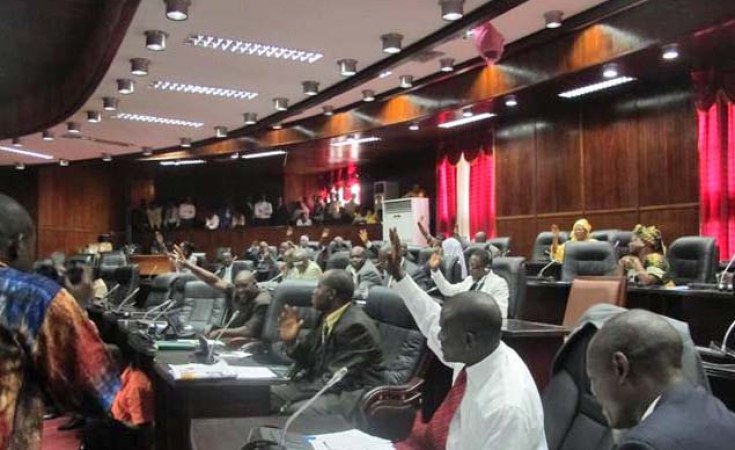
The long-simmering land crisis in Liberia has returned to the national spotlight, with the Senate summoning key government institutions amid mounting tensions over double land sales, disputed deeds, and controversial demolition orders stemming from court rulings.
Acting on a communication from River Gee County Senator Jonathan Sogbie, the Senate has cited the Liberia Land Authority (LLA), the Ministry of Lands and Mines, the Ministry of Public Works, and the Liberia National Police (LNP) to appear before the Committee of the Whole on March 12, 2026. Lawmakers say the issue is no longer a series of isolated disputes but a creeping national conflict with the potential to destabilize communities.
"Land dispute is becoming a national conflict that should be treated with urgency," declared Montserrado County Senator Abraham Darius Dillon during a heated floor debate on Tuesday, March 3.
Keep up with the latest headlines on WhatsApp | LinkedIn
Land has historically been at the heart of Liberia's political and social tensions. From the 19th century settlement policies that created parallel systems of statutory and customary land ownership, to post-war urban expansion, unclear land tenure has fueled mistrust and conflict.
After the civil wars (1989-2003), thousands of displaced Liberians returned to find their land occupied, sold, or reassigned. Weak documentation systems and overlapping claims created fertile ground for fraud. In urban centers like Monrovia and Paynesville, rising land values intensified speculative sales, often resulting in multiple deeds for the same property.
The establishment of the Liberia Land Authority in 2016 was intended to unify land governance and modernize documentation. The landmark Land Rights Act of 2018 further sought to clarify customary and private land ownership. Yet implementation gaps, inadequate digitization, and lingering corruption have limited their full impact.
Over the years, land disputes have repeatedly surfaced as catalysts for community unrest. Violent confrontations between families, prolonged court battles, and forced evictions have become common features of Liberia's property landscape.
The Senate recalled that land-related controversies even featured prominently in the impeachment proceedings of former Supreme Court Justice Kabineh Ja'neh--a reflection of how deeply land disputes have penetrated state institutions.
Double Deeds and Demolitions
The latest controversy centers on cases where courts allegedly issued multiple deeds for the same parcel of land, resulting in eviction orders and demolitions.
Senator Dillon accused some judges of failing to exercise due diligence. "If a judge is issuing multiple deeds for the same land, that judge must be stopped and must face impeachment," he said, suggesting that such acts amount to serious misconduct.
He further proposed that issuing multiple deeds for the same property should become an unbailable offense and called for judicial reforms that could allow impeachment proceedings where deliberate wrongdoing is established.
The Senator also advocated for the digitalization of Liberia's land registry system, arguing that a centralized electronic database would immediately flag attempts to sell already registered property.
"When everything is entered into a digital system, it will immediately show that the land is not available, and those involved in double selling will be caught," Dillon said.
Behind the legal and legislative debates are thousands of Liberians facing emotional and financial distress.
"Imagine people who have stayed on land for ten or fifteen years, built houses, raised families, and suddenly someone appears with documents claiming ownership," Dillon told colleagues. "That is creating confusion and tension in our communities."
Such cases often leave families displaced after investing life savings into homes or businesses. In densely populated counties like Montserrado, forced evictions triggered by competing claims have sometimes escalated into standoffs requiring police intervention.
Bomi County Senator Edwin Melvin Snowe warned that unresolved land conflicts have historically fueled instability.
"If nothing drastic is done about double sales of land and ownership disputes, this could become another source of civil conflict in this country," Snowe cautioned.
The Senate's decision to summon the LLA, MLM, the MPW, and the LNP recognition that the crisis is multi-dimensional.
The LLA is responsible for land registration and administration, the LLA's modernization efforts are central to preventing overlapping deeds, and the MLM oversees land policy and allocation frameworks, while the MPW is involved in land demarcation and infrastructure planning, which can intersect with property claims. For the LNP, it is often called upon to enforce court-ordered demolitions or eviction notices.
By convening these agencies collectively, the Senate is positioning the issue as a systemic governance failure rather than an isolated judicial anomaly.
The intervention of lawmakers could prove pivotal. Senators are not only exercising oversight but also acknowledging their legislative responsibility to refine the legal framework governing land ownership and dispute resolution.
Dillon stressed that speeches alone would not suffice. "We are lawmakers here... speeches alone will not solve the problem. We must take action."

Sign up for free AllAfrica Newsletters
Get the latest in African news delivered straight to your inbox
Some reform initiatives proposed in the past include reviewing land and probate laws to eliminate ambiguities, digitalizing national land records, strengthening penalties for fraudulent double sales, and enhancing oversight of judicial handling of land cases.
If implemented effectively, these measures could restore public confidence in property rights--a cornerstone of economic development and social stability.
The land crisis in Liberia is more than a legal dispute; it is a test of institutional coordination, judicial integrity, and legislative courage. Land remains the most valuable asset for many Liberians. When ownership is uncertain, investment declines, community cohesion weakens, and mistrust in the state deepens.
The Senate's engagement reflects growing recognition that unresolved land disputes threaten not only individual livelihoods but national peace.
As Senator Dillon concluded, "The real problem lies within our hands as lawmakers, and we must be courageous enough to review the law and fix the system."
Many hope that the March 12 hearing marks the beginning of comprehensive reform or another chapter in a protracted struggle will depend on the political will to modernize land governance and confront entrenched practices. It is very clear now that the country's land question can no longer be deferred.

