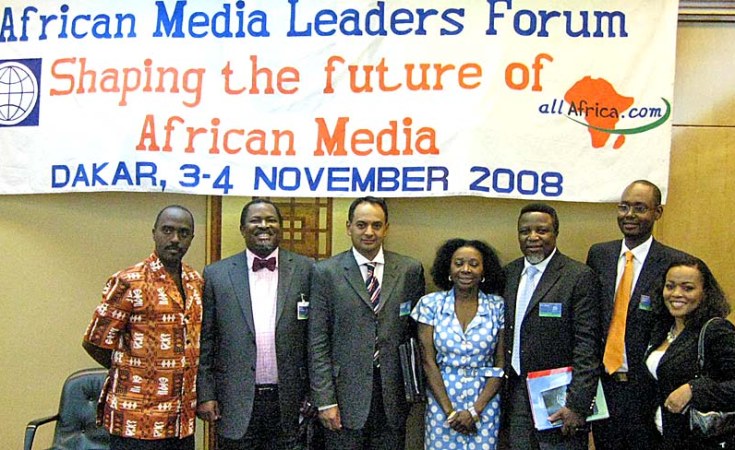
Dakar — Pioneering African media leaders who are meeting in Dakar have called for closer co-operation among publishers and broadcasters across the continent to promote development.
Participants in the inaugural meeting of the African Media Leaders’ Forum – co-sponsored by The World Bank and allAfrica.com – were discussing challenges facing the media on the first of two days of discussions in Dakar.
In a vigorously-argued contribution to the forum, Nduka Obaigbena, the founding editor-in-chief and chairman of Nigeria’s THISDAY newspaper, advocated a blueprint for the development of media in Africa based on an acceptance of the efficacy of markets.
Follow us on WhatsApp | LinkedIn for the latest headlines
The continent’s media needed “partners and investors, not donors… It is not as if we are begging,” he said. Until publishers improved the capacity of their journalism, they would not earn the respect they needed to attract more readers, and thus more advertising. “Let’s produce damned good products,” he urged.
Linus Gitahi, the chief executive officer of East Africa’s Nation Media Group, wanted media leaders to find ways of sharing content across the continent “to tell the African story in an African way” instead of relying on Western-generated news about the continent, which often meant news was misreported or not reported at all.
He also called for African media leaders to pool resources for training and for more focus on bringing more radio broadcasters – who reached much bigger audiences than newspaper – to join other media leaders in planning for the future.
Hoosain Karjieker, chief operating officer of South Africa’s Mail & Guardian Media, told the forum that “if you’re an independent media house, it’s a risky world out there.”
Citing examples from countries across southern Africa, he said there was growing pressure from governments to set up statutory media councils to control journalists. Battles of the past were having to be revisited, he said, to educate “a new generation of politicians” on the need for free media.
Senegalese publisher Baye Dame Wade recounted how he had used his savings to leave his work as an economist and launch a business magazine, entitled Reussir. In the early days, he acted as owner, manager, reporter and secretary, writing every word of the magazine himself. Now, 28 issues later, the magazine had built up the trust of decision-makers, who opened up and communicated with it.
Thierry Hot of the Burkina Faso-based magazine and website, Fasozine, called for the establishment of training courses in skills such as media management for publishers in Africa. He also advocated collaboration among publishers so they could learn from one another about such practical issues as methods of distribution, and even share co-operatively-owned printing presses.

Sign up for free AllAfrica Newsletters
Get the latest in African news delivered straight to your inbox
Azubuike Ishiekwene, executive director (publications) of Punch Publications Nigeria, said the major challenges the media faced were the quality of journalism, effective management and legal and ethical issues.
Quality journalism was the key to attracting readers to newspapers when they had so many other ways of accessing news, he said. Management challenges included the recent doubling of newsprint prices and the lack of nationally-accepted audited circulation statistics.
Legal challenges were inhibiting the press, Ishiekwene said. It was a battle to persuade society that laws guaranteeing freedom of information were in the interests of not only the media, but were a means of enabling ordinary citizens to hold their leaders to account.
The forum, which will be expanded to include more publishers and broadcasters from across the continent as it becomes more firmly established, has three central objectives, according to a statement tabled at the Dakar meeting:
* To listen to media owners about the kinds of support they need to address deeply-rooted problems in their industry;
* To begin a discussion about content, the role of the media in development and the links between regional development and long-term business interests of the media; and
* To take up a discussion started by the European Union and African Union about the links between repressive policy environments and the lack of journalistic ethics, and to encourage consensus around the need for a journalistic code of conduct.

