Uganda's Ebola Death Toll Rises
Four more people have died from the Ebola virus that has gripped the country. The government has urged citizens to minimise physical contact to ensure that the virus does not spread.
Video
-
Uganda: Ebola Death Toll Rises
- Publisher:
- Al Jazeera English
- Publication Date:
- 31 July 2012
The death toll from an outbreak of Ebola in villages in western Uganda has risen.President Yoweri Museveni confirmed that the deadly virus has hit ... see more »
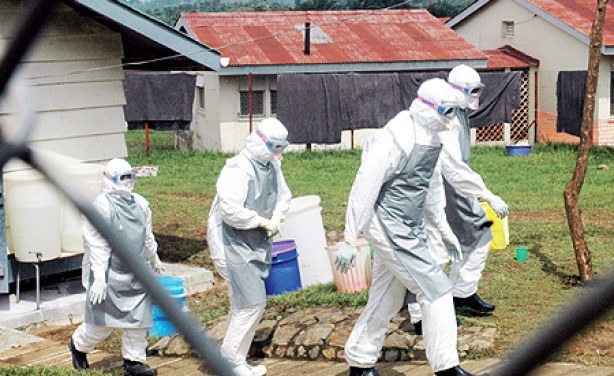
Medical workers in protective gear leave an Ebola isolation camp during the 2007 outbreak (file photo).
InFocus
-

Districts neighbouring key border points have been put on high alert after health officials warned of a possible spread of the Ebola haemorrhagic fever. Read more »

Comments Post a comment
PRESS RELEASE July 19, 2012, 8:31 a.m. EDT Sarepta's Ebola Virus Drug Shows Survival in Primates Despite Delayed Treatment Drug Shows 100% and 83% Survival When Administered 48-Hours and 96-Hours Post-Infection
CAMBRIDGE, MA, Jul 19, 2012 (MARKETWIRE via COMTEX) -- Sarepta Therapeutics, Inc. SRPT -4.22% , a developer of first-in-class RNA-based therapeutics, announced today that its lead therapeutic drug candidate for the Marburg virus, AVI-7288, demonstrated up to 100% survival in a non-human primate (NHP) study exploring the drug's effect when treatment is delayed to various time points post-infection. The study demonstrated a significantly higher rate of survival among NHPs treated with AVI-7288 compared to the placebo-treated group when treatment was administered up to 96-hours post infection. Sarepta is conducting this work under a U.S. Department of Defense (DoD) contract managed by the Joint Project Manager Transformational Medical Technologies (JPM-TMT) Project Management Office, a component of the Joint Program Executive Office for Chemical and Biological Defense (JPEO-CBD).
"These results are unprecedented and demonstrate a compelling proof of concept with our PMOplus(R) chemistry platform and its ability to treat the most lethal and fast-acting viruses, without compromising efficacy of survival even after up to a four-day delay in the initiation of treatment," said Chris Garabedian, President and Chief Executive Officer of Sarepta Therapeutics. "These results represent a significant advancement toward the protection of our service members and the civilian population in the event of a bioterrorist attack. Extending the window of opportunity for effective medical intervention against lethal infections may translate to more lives saved."
This study showed a high degree of survival between 83% and 100% in each of four post-exposure cohorts that received daily treatments with AVI-7288 beginning one-, 24-, 48-, or 96-hours after infection, compared to 0% survival in the placebo-treated control group. Currently at Day 27, the study will continue to monitor the surviving non-human primates until study termination at Day 41.
The work is a collaborative effort between Sarepta and scientists at the U.S. Army Medical Research Institute of Infectious Diseases (USAMRIID), the DoD's leading medical research laboratory for biological defense, which has the DoD's only maximum containment, or Biosafety Level 4, capability.
If the hospitals do not have money to buy food for the (few) patients then there is no money for their proper treatment. I would assume that containing the spread of Ebola and detecting its presence require the health authorities to spend money that they might not have. If Uganda does not have the resources to address this wave of Ebola it should ask for assistance.